

Showing posts with label genome. Show all posts
Showing posts with label genome. Show all posts
Saturday, January 31, 2015


Thursday, November 20, 2014
The Amazing Cell!
 A couple of years ago, I came across a presentation given at one of the TED conferences by a Drew Berry. If I would have a guess, many non-biologists would be really bored with a talk on cell division, right? But no, not this one, it was most interesting, using computer animation, he exposed the cell division process in great detail - and made it breath taking for everyone!
You see, attached to sister chromosomes is something called the "kinetochore" which contains around 200 types of proteins but thousands in all. This little structure acts as an anchoring site for microtubules, part of the cell scaffolding. Microtubules help pull the two daughter chromosomes apart.
But the interesting part is this, the kenetochores are sending out little chemical and motor signals to indicate when the cell will divide! In fact, Drew called the kenetochore a "signal broadcasting system."
The implications of this structure alone are astounding. Along with many other types of epigenetic information within the cell, these attachment sites hold one of the most illustrious keys to the mysterious dividing cell. One can see a designer's creative abilities at play with structures like this. It's mind boggling that such an elegant structure, such as this, doesn't kindle more awe responses from people towards an amazing creator!
I would encourage you to take a look at it for yourself!
Image credit: Flicker/Mehmet Pinarci
Friday, November 14, 2014
What Is The Difference Between Shannon Information and Specified Complex Information? And why it's important.
Information is interesting, here I want to specifically discuss Shannon Information verses Specified Complex Information. I know, you may be saying "so what, it sounds boring to me." Maybe so, it may even zip over your head, in that case duck so it will hit the person behind you! While being of an esoteric philosophical nature, I think it's significant because of its implications.
There's a view that information in DNA and biological systems contain just Shannon Information - this is not true. Yes, biological systems do contains Shannon Information, but it is more specific than that - it contains Specified Complex Information. Let me first define the two and then tell you why biological systems have Specified Complex Information and why this discussion is so important.
 |
The Difference Between Shannon Information and
Specified Complex Information
|
Shannon Information verses Specified Complex Information
Shannon Information is only concerned with the improbability or complexity of character strings. In other words, it's just mere complexity or it has information-carrying capacity. Specified Complex Information on the other hand, is complex, but also has patterning significance. This is functional information that carries meaning.
Let me put it this way, all Specified Complex Information is Shannon Information, but not all Shannon Information is Specified Complex Information (see bottom half of the meme). For example, Shannon Information just means that a string of characters are complex and improbable in their arrangement, but it does not define if this string carries significant meaning. Again, Specified Complex Information is specified and always carries meaning.
For example, this is Shannon Information:
“dfsad sdaf oije .zvsdlkfjas sdlfj” and also can be “Learning about information is fun!”However, Specified Complex Information always carries meaning:
“Learning about information is fun!”
“dfsad sdaf oije .zvsdlkfjas sdlfj” is not specified functional information - at least as far as I know, it holds no meaning to an English speaker!
In case you did not get that, let me put it this way. Consider a key and lock. You can take a key blank and file down any pattern on the key blade - that is Shannon Information. However, if you want the key to fit the lock, you have to cut the key blade to specified sequences, shapes and depths for proper key-lock fit. Now that is Specified Complex Information.
In case you did not get that, let me put it this way. Consider a key and lock. You can take a key blank and file down any pattern on the key blade - that is Shannon Information. However, if you want the key to fit the lock, you have to cut the key blade to specified sequences, shapes and depths for proper key-lock fit. Now that is Specified Complex Information.
Biological Systems and Text on the Page
Now both the text you are reading and DNA are improbable and complex. However, both carry meaning. The text you are reading is telling you something in English. DNA contains information that transcribes to RNA that gets translated to protein. In fact those sequences must be in a specific order else the organism will not produce the correct protein, a protein that does not function well or maybe none at all! The organism's enzymes must be able to transcribe it, if there is no correct sequence, there is no transcription.
Why Know the Difference?
Oh, by the way, just so you know why this distinction is so important, Specified Complex Information is only generated from a mind. In fact, that is the only source we know of that produces this type of information! Think of the text you are reading now, it has come from my mind. Thus this leads to the conclusion that life's specified informational core is grounded in intelligence - an intelligent mind!
Have you heard materialists say the "DNA is just Shannon Information" so it can arise by chance? What do you think, have you gained a new level of respect for "Information theory?"
Have you heard materialists say the "DNA is just Shannon Information" so it can arise by chance? What do you think, have you gained a new level of respect for "Information theory?"
Thursday, May 15, 2014
Life's New Language
 |
| Artistic DNA molecule. Flicker/Keith Ramsey |

Yes, it is quite interesting that a group of scientists, Floyd Romesberg and team from Scripps Research Institute, were able to manufacture chemicals that were quite different from DNA's four bases: adenine, thymine, cytosine and guanine (A, T, C and G respectively). To be frank it think the research is quite interesting.
The bases engineered by Romesberg’s team are more alien, bearing little chemical resemblance to the four natural ones (1).These new alien DNA bases, d5SICS and dNaM, were integrated into the microbes genome - this is the core of all the hubbub. Enzyme machines that help copy and translate the genetic code were able to interact with these novel bases.
Some are saying that we may be able to manufacture new drugs and unprecedented cures come from this research. In other words, with new letters one will be able to make new genetic words, which will expand the potential protein results.
My Perspective
However, I do have ten observations concerning this study, some on the skeptical side:- Great, they accomplished adding new, man-made bases to a bacteria's DNA. But at this time the cell has no way of making more, if the microbe's human farmers discontinue supplying the cells with these bases, these bases will no longer be coded within the cell. Traditional bases will replace these artificial bases places.
- These bases are said to add information potential of the genome. This may be good, however, even with our computer systems, with only two "alphabets" (0 and 1), we are able to make images, videos, text, music, manufacture complex 3D objects and you name it. DNA already has twice as many "alphabets" as our technology, four bases (not counting the 64 codon combinations and used to put together 20 amino acids).
- OK, we have two new bases, so what about the RNA and all the protein complexes that help make protein? Yes, we can copy the text, but what about protein manufacturing? It is one think to copy text, but it is another to use text to build an aircraft. There is a whole level of magnitude above this accomplishment needed to even think about making protein.
- Proteins are made up of amino acids. The are attached to something called tRNA and are used to help build protein. So one is going to have to build "machines" help specify new amino acids to the correct new bases that make up the tRNA. Where will these machines come from? How will they be coded? What molecular machines will be automated to make them? There is a vicious loop going on here.
- To make protein, we need amino acids. Even if we get amino acids to "stick" to the novel tRNA and rRNA, we have to get the amino acids to form protein.
- We finely make a new protein. But form equals function. In other words, a protein needs to be folded just right for very specific jobs. Little machines, called chaperons, help fold proteins in the correct and usable shapes. Where are these new chaperons coming from for the new proteins with new types of amino acids? In other words, new code and new machines will have to be designed to fold the new proteins into correct orientations to even be potentially usable.
- They credit the origins of our current nucleotide bases to evolution through deep time. No intelligent source is invoked. However, it took a group of intellectual researchers over fifteen years to just get these microbes to uptake and replicate these artificial letters. This does not count the many other researchers, since the 1960's, who also have been attempting to work toward this goal. It took intelligence to get as far as they did, how could a blind, undirected process come up with four bases? It is even worse than that, think about it, as of now, the microbes can't even uses these bases for anything. They just sit there and get replicated. This hole system is irreducible complex, unless all the parts were in place in the first cells, the original bases would not have functioned.
- Along with this, we only know of information arising through intelligent minds. It is the inferences to the best explanation and the law of uniformity. Pure naturalism is not enough. As said on the point above, this study demonstrates this argument lucidly.
- Lead researcher Romesberg said the following within a piece in Nature: "If you read a book that was written with four letters, you’re not going to be able to tell many interesting stories" that is why these new bases are important, they will extend the informational content (1). Again, sounds good except for when one looks at even a simple cell, one is totally amazed by the stunning design and complexity. It makes our greatest accomplishments seem like foolish children's play. The biological story is one of the most interesting "stories" that can be told!
- Lastly, a quote from Romesberg states the following: "This shows that other solutions to storing information are possible and, of course, takes us closer to an expanded-DNA biology that will have many exciting applications—from new medicines to new kinds of nanotechnology" (2). Why does it seem as if all cutting edge (maybe on the offbeat side) "research" is argued to help with health, medicine or improve technology? It seems to me that they trying to validate their research by saying "hey, this sounds a little silly, but it really does have importance." OK, maybe I am cynical, but that's what it sounds like!
(1) Callaway, Ewen. "First life with 'alien' DNA" http://www.nature.com/news/first-life-with-alien-dna-1.15179
(2) Scripps Research Institute Scientists Create First Living Organism that Transmits Added Letters in DNA 'Alphabet'. http://www.scripps.edu/news/press/2014/20140507romesberg.html
Monday, April 14, 2014
The Mystery of the Secret Code
Let me tell you a little secret, your body is made up of about 100,000 billion cells. All these come from one cell. Amazing. But wait there is more, inside each of your cells you have longs strands called DNA. These strands carry information, much like the text you are reading now.
This is amazing right? But there is more, there are specific sections of your DNA that supply the instructions for the manufacturing of the building blocks of life, protein. These segments were recently shown to contain two layers of information! However, we already talked about this in a previous post. So you're like, I know already.
Another study has came out with more to add. Protein coding regions are not the only locations that contain this duplex layer of information. Non-coding regulatory regions are duplex as well!
Think of it this way, you're a cook holding a cook book. Great, but you need some information such as measurement conversions, they type of recipe you want to pick from, etc. So you either go to the index or the outline in the front. Maybe you go to the conversion table in the back of the book. Think of the regulatory regions as the areas that contain this type of information.
While the "recipe" contains two layers of instructions, the "index" and "conversion tables" also contains double meanings. In this study, using zebrafish DNA, the two layers of this regulatory region get used at different times in its life! This highly condensed design is amazing!
Haberle, V. et al. 2014. Two independent transcription initiation codes overlap on vertebrate core promoters. Nature. doi:10.1038/nature12974.
This is amazing right? But there is more, there are specific sections of your DNA that supply the instructions for the manufacturing of the building blocks of life, protein. These segments were recently shown to contain two layers of information! However, we already talked about this in a previous post. So you're like, I know already.
Another study has came out with more to add. Protein coding regions are not the only locations that contain this duplex layer of information. Non-coding regulatory regions are duplex as well!
Think of it this way, you're a cook holding a cook book. Great, but you need some information such as measurement conversions, they type of recipe you want to pick from, etc. So you either go to the index or the outline in the front. Maybe you go to the conversion table in the back of the book. Think of the regulatory regions as the areas that contain this type of information.
While the "recipe" contains two layers of instructions, the "index" and "conversion tables" also contains double meanings. In this study, using zebrafish DNA, the two layers of this regulatory region get used at different times in its life! This highly condensed design is amazing!
Haberle, V. et al. 2014. Two independent transcription initiation codes overlap on vertebrate core promoters. Nature. doi:10.1038/nature12974.
Wednesday, April 9, 2014
Genetically Modified Tomatoes
Are genetically modified (GM) foods bad for you? This is a controversial topic and at this time I am not going to talk about that question entirely. Nor am I here right now to discuss the ethics of manipulating genes. However, recently there was a study that pointed out that there were no large unintended genetic consequences in the GM tomato's which were designed to resist ripening.
(1) Crop Science Society of America. "New approach to detecting changes in GM foods." ScienceDaily. ScienceDaily, 3 April 2014. <www.sciencedaily.com/releases/2014/04/140403131942.htm>.
When the scientists compared the biochemicals of the GM tomato and a wide assortment other non-GM tomatoes, including modern and heirloom varieties, they found no significant differences overall. Thus, although the GM tomato was distinct from its parent, its metabolic profile still fell within the "normal" range of biochemical diversity exhibited by the larger group of varieties. However, the biochemicals related to fruit ripening did show a significant difference -- no surprise because that was the intent of the genetic modification (1).All in all, it seems that the scientists were able to edit the genome as they intended with no other large unintended genetic changes, which is good. But I do have two questions. First do these "extended ripening genes" have any adverse human consequences? Second, for this tomato it sounds like these ripening genes still fall within the normal tomato range of genes. But what is this "normal" range and what measurement did they use?
(1) Crop Science Society of America. "New approach to detecting changes in GM foods." ScienceDaily. ScienceDaily, 3 April 2014. <www.sciencedaily.com/releases/2014/04/140403131942.htm>.
Friday, March 21, 2014
"Superbugs" In Sewage
 |
| Image source: Iqbal Osman/Flickr. |

Tests at two wastewater treatment plants in northern China revealed antibiotic-resistant bacteria were not only escaping purification but also breeding and spreading their dangerous cargo.
Joint research by scientists from Rice, Nankai and Tianjin universities found "superbugs" carrying New Delhi Metallo-beta-lactamase (NDM-1), a multidrug-resistant gene first identified in India in 2010, in wastewater disinfected by chlorination. They found significant levels of NDM-1 in the effluent released to the environment and even higher levels in dewatered sludge applied to soils (1).
How do they become resistant?
Antibiotic resistant bacteria become resistant when there's a mutation or they acquire an antibiotic resistant gene from another bacteria. Even though we think that this is bad, from the bacteria's perspective it gives them greater flexibility in different environments.Does this prove evolution?
Some have advocated that superbugs are evidence for macro-evolution. However, this is not so. These resistant bacteria are still bacteria before and after they have the gene. They have never changed to a different type of creature. In fact, some bacteria have had the capability to be resistant to our antibacterials even before those antibacterials were marketed. These means that these capabilities were already built in to the bacterial population for greater survival potential.(1) http://phys.org/news/2013-12-superbugs-sewage.html#jCp
Friday, March 7, 2014
Throw Your Genome Away!

In a recent article by Dr. Tomkins, he writes the following:
It was once believed that the regions in between the protein-coding genes of the genome were wastelands of alleged nonfunctional “junk DNA.” However, we now know that these previously misunderstood regions are teeming with functional activity—and a new study shows they are actually required for life (1).The idea of junk DNA is another area where the evolutionary ideology has failed us. Only about 1-5% of the DNA codes for protein. The rest of the DNA was assumed by many to be leftovers from evolutionary ancestors. Most who held to this view were biologists with evolutionary presuppositions. Directly steming from this assumption, much of the genome regions went unexplored for years.
Now we know different. In fact most of the DNA has been assigned roles, very important roles within the cell. Interestingly, many of those who held to the view of life originating from a deity, have for years theorized function to most of the "junk DNA". Truly, as the old saying states "ideas have consequences."
(1) Quoted text and image are from the following source: Jeffrey Tomkins, Ph.D., . N.p.. Web. 3 Mar 2014. <http://www.icr.org/article/7875/>.
(1) Quoted text and image are from the following source: Jeffrey Tomkins, Ph.D., . N.p.. Web. 3 Mar 2014. <http://www.icr.org/article/7875/>.
Friday, February 28, 2014
Double Function: DNA Code and Duons
Cells are the "building block of life", they form organisms. Inside, DNA resides, storing the instructions that tell how to build proteins. Protein are made up of something called called amino acids. The instructions in the DNA are called genes. However, the DNA has other functions as well, it regulates some of the cell's activities.
DNA code seems to have multiple layers of information, from molecular tags. Much of the information outside of the DNA is called the epigenome.
While genes and epigenomes are interesting, there is evidence that DNA itself, the four letters that make up the DNA (A, T, C, and G), contain at least two layers of information. One that directs the sequence of the amino acids to make protein. The other helps regulate where types of molecular machines can copy the code to make RNA, an intermediate between DNA and protein. This is a regulatory function. These instructions are found many places on the DNA code. However, some of it is found coded right with the genes, in the same sequences that code for protein!
The sequence of the DNA is "nonrandom". This means that these genes are highly specified. They need to be, they are carrying at least two layers of information on some genes. The writers of the below study state the following: "The information architecture of the received genetic code is optimized for superimposition of additional information." This causes a simultaneous encoding of amino acids and regulatory information within exons, the parts of the gene that code for protein.
We only see information come from a mind. In this case, we have two layers of information, in the same "text". Think of reading a book. Now what if you turned the book and read it in another direction, ore even backwards. While doing this, the author has written more information that is with in the same text that you were just reading. You have a very compact book with couple layers of information. Just one layer of information points to a creator. However, given that we find at least two layers of information makes it even more stunning. Two layers makes it even more stunning and exponentially points to a mindful origin.
Stergachis, A. B. et al. 2013. Exonic Transcription Factor Binding Directs Codon Choice and Affects Protein Evolution. Science. 342 (6164): 1367-1372.
DNA code seems to have multiple layers of information, from molecular tags. Much of the information outside of the DNA is called the epigenome.
While genes and epigenomes are interesting, there is evidence that DNA itself, the four letters that make up the DNA (A, T, C, and G), contain at least two layers of information. One that directs the sequence of the amino acids to make protein. The other helps regulate where types of molecular machines can copy the code to make RNA, an intermediate between DNA and protein. This is a regulatory function. These instructions are found many places on the DNA code. However, some of it is found coded right with the genes, in the same sequences that code for protein!
The sequence of the DNA is "nonrandom". This means that these genes are highly specified. They need to be, they are carrying at least two layers of information on some genes. The writers of the below study state the following: "The information architecture of the received genetic code is optimized for superimposition of additional information." This causes a simultaneous encoding of amino acids and regulatory information within exons, the parts of the gene that code for protein.
We only see information come from a mind. In this case, we have two layers of information, in the same "text". Think of reading a book. Now what if you turned the book and read it in another direction, ore even backwards. While doing this, the author has written more information that is with in the same text that you were just reading. You have a very compact book with couple layers of information. Just one layer of information points to a creator. However, given that we find at least two layers of information makes it even more stunning. Two layers makes it even more stunning and exponentially points to a mindful origin.
Saturday, February 22, 2014
Things I Have Learned From Dr. Steven Meyer
Throughout the years I have listened and have learned from Dr. Steven Meyer. I agree with most concepts he presents, but do take exception to others. However, this post is not about this arguments, rather his methods and tactics in presenting and talking to those who oppose his views. I am impressed by how he handles himself in conflicting situations. Because of this, I have tired to isolate attributes that I can learn from.
There are three main categories: his personal attributes, his conflict handling persona, and how he argues his case.
There are three main categories: his personal attributes, his conflict handling persona, and how he argues his case.
Personal Character
He comes across as intellectual but illustrative, making the complex simple. His dress and demeanor does not draw attention away from his arguments. I remember him and his arguments, not some sort of jazz, fancy or sloppy clothing. While intellectual, he is still modest and minimizes himself in debate. He ignores it when people don't call him "Doctor" or when others minimize his credentials.Handling Conflict
When I see him in conflict, he handles himself well. I think part of this comes for confidence and knowledge of the subject material. However, he is open to critique and is fair minded. He admits mistakes and he is willing to learn from his antagonist. He critiques the arguments rather than his antagonist. Lastly, he is quick witted and he is open to dialog with anyone.Arguing His Case
I like how he argues his case. He makes modest claims which have much evidence. He uses what I would call "minimalist argumentation method," he focuses on things that provide the best arguments and gives the greatest evidence supporting those arguments. In other words, he uses only few topics but gives powerful arguments for them. This gives him less "turf" to defend. This allows him to stay focused and reduce sidetracking. Other issues are often baited in front of him, he does not budge, he stays focused and argues for his modest claims.Sunday, January 19, 2014
Antibacterial, The Good, The Bad and The Ugly
While talking to an office manger of a company who purchased, among other things, hand soap, I stated that I had noticed that she bought antibacterial hand soap. From her perspective it seemed better, hey it is antibacterial, bacteria are bad so let's get soap that kills them. However, I can think of three good reasons NOT to use antibacterial products unless in high risk environments.
1) there is excess exposure to not needed potentially harmful chemicals
2) many of the “good bacteria” that help you and protect you from the “bad bacteria” are kill off by these products
3) these products promote antibiotic resistance in bacteria *
However, this subject brings up another issue. In one of my past biology classes, the professor tried to use antibiotic resistance to demonstrate that “molecules-to-man” evolution was correct. However, there were a number of things he left out. He “forgot” to tell us that microbes scientists have been studying within the last couple hundred years have not evolved into a new type of organism, in fact, they have not even crossed the species barrier to become a new type of bacteria. One type of bacteria, E. Coli, has had its genetic structure changed by natural and human cause in the lab. They have been growing in diverse situations in the labs for millions of generations. Amazingly, these bacteria are still E. Coli. They many have different functions, or less functions, but they still have the characteristics of E. Coli.
You see, antibiotic resistance does not demonstrate “molecules-to-man” evolution, but rather highly designed organisms that are able to protect its population. Within its microbial populations, these antibiotic resistant bacteria do not function optimally under normal situations, but in an antibacterial environments they function well and keep the species alive. So that is the reason you should not use these antibacterial products indiscriminately.
* Antibiotic Resistance is a condition when bacteria become resistant or immune to some chemical that is designed to kill them. In other words, you take penicillin, an antibiotic, and it kills the “bad” bacteria. However, if there are bacteria within that population that are not effected by the antibiotic, then those bacteria will grow uncontrolled. Soon, if all the non-resistant bacteria are killed off, only the resistant ones will be alive. Resistance to antibiotics are caused in one of three ways: 1) some germs already had the resistance, in most any population of bacteria there are a very few bacteria that are resistant already to certain antibiotics, this creates a 'safety net' so that the bacteria will continue to survive even through adverse conditions. However some are even resistant before a certain new antibiotic comes out! 2) Resistance can be transferred from one germ to others, this can be achieved multiple of ways. 3) Some microbes can become resistant to antibiotics through mutation. This is when a gene in an organism is changed from highly organized to one that is degraded. This makes it act different, like it does not have a port that would uptake the antibiotic.
1) there is excess exposure to not needed potentially harmful chemicals
2) many of the “good bacteria” that help you and protect you from the “bad bacteria” are kill off by these products
3) these products promote antibiotic resistance in bacteria *
However, this subject brings up another issue. In one of my past biology classes, the professor tried to use antibiotic resistance to demonstrate that “molecules-to-man” evolution was correct. However, there were a number of things he left out. He “forgot” to tell us that microbes scientists have been studying within the last couple hundred years have not evolved into a new type of organism, in fact, they have not even crossed the species barrier to become a new type of bacteria. One type of bacteria, E. Coli, has had its genetic structure changed by natural and human cause in the lab. They have been growing in diverse situations in the labs for millions of generations. Amazingly, these bacteria are still E. Coli. They many have different functions, or less functions, but they still have the characteristics of E. Coli.
You see, antibiotic resistance does not demonstrate “molecules-to-man” evolution, but rather highly designed organisms that are able to protect its population. Within its microbial populations, these antibiotic resistant bacteria do not function optimally under normal situations, but in an antibacterial environments they function well and keep the species alive. So that is the reason you should not use these antibacterial products indiscriminately.
* Antibiotic Resistance is a condition when bacteria become resistant or immune to some chemical that is designed to kill them. In other words, you take penicillin, an antibiotic, and it kills the “bad” bacteria. However, if there are bacteria within that population that are not effected by the antibiotic, then those bacteria will grow uncontrolled. Soon, if all the non-resistant bacteria are killed off, only the resistant ones will be alive. Resistance to antibiotics are caused in one of three ways: 1) some germs already had the resistance, in most any population of bacteria there are a very few bacteria that are resistant already to certain antibiotics, this creates a 'safety net' so that the bacteria will continue to survive even through adverse conditions. However some are even resistant before a certain new antibiotic comes out! 2) Resistance can be transferred from one germ to others, this can be achieved multiple of ways. 3) Some microbes can become resistant to antibiotics through mutation. This is when a gene in an organism is changed from highly organized to one that is degraded. This makes it act different, like it does not have a port that would uptake the antibiotic.
Friday, December 13, 2013
Elegant Design In A Cell
In freshman year biology, students learn the amazing complexities of the cell. For example, we have been told for years of the cells amazing four letter alphabet or the genome. Of course we know that information always comes from a mind, at least that is our everyday experience (books we read, conversations we have). Just this level of biologically understanding should point one to a creator. However, this is truly just the tip of the iceberg.
What most don't realize is that the DNA is not the only information carrier in the cell. RNA, a close cousin of DNA and copied from DNA, also caries information. But wait, that is not all, there are little, and not so little, tags on the genes that tell the cell to do certain things. These tags included methyl and acetyl groups among other tags.
n emerging field called epigenetics, layers of information above the DNA. Even the cell structure is now being recognized to hold information. Part of the internal cell scaffolding is now thought to contain parts of this information. More we learn about this information, the more complex just one cell gets. Material does not create information randomly or systematically. Information needs a mind for causation. This translates into what many of us knew already, designs like this need a designer.
Image source: "Epigenetic mechanisms" by National Institutes of Health
Other Information
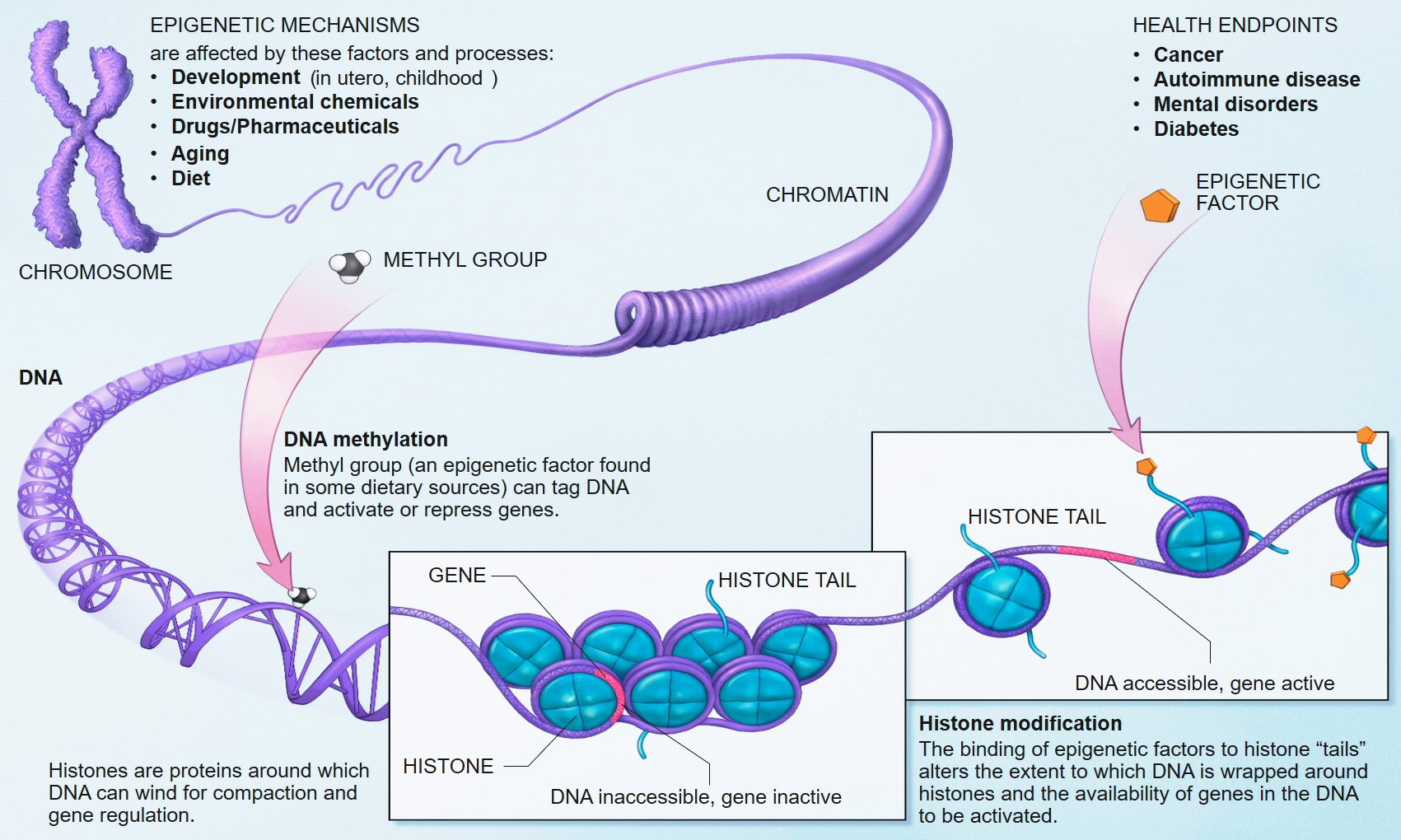 |
| Epigenetic mechanisms: Click image for full illustration. |
Epigenetics
In fact, these tags are just the small part of an emerging field called epigenetics, layers of information above the DNA. Even the cell structure is now being recognized to hold information. Part of the internal cell scaffolding is now thought to contain parts of this information. More we learn about this information, the more complex just one cell gets. Material does not create information randomly or systematically. Information needs a mind for causation. This translates into what many of us knew already, designs like this need a designer.
Image source: "Epigenetic mechanisms" by National Institutes of Health
Subscribe to:
Posts (Atom)