Showing posts with label evolution. Show all posts

Sunday, April 10, 2016

One Life Mystery That Is Destroying Darwinism But Points To The Creator

Exponential Life - Epigenetics Deepens the Mystery of Design

I was blown away when the scientist said it; my mind yelled, "What? That's crazy!" His topic was the famous, or maybe infamous, tiny friend living down in our lower digestive tract, Escherichia coli (E. coli) bacteria. He said that, on average, any given strain of E. coli shares about twenty percent of its core genes with any other E. coli -bacterial strain. In other words, about twenty percent of the E. coli genes are shared by all strains, but around eighty percent can very throughout the species!*

One possible explanation for this phenomenon is that other information-carrying structures besides deoxyribonucleic acid (DNA) may partly define the E. coli's final shape. This was startling news to me, for throughout my early biology education, I had understood DNA to be something like destiny.*

Thursday, July 9, 2015

A Very Obvious Reason Biology Points To God! (Which You May Not Have Thought About)

Once I met a German engineer working to reinvent the vacuum cleaner. When I say reinvent, I mean that! A totally different design. If he and his team were successful, they would do well. If not, he would be knocking on doors for a new job.


Hard, Hard Work!

Engineers, designers and artists understand how hard it is to design. It is time intensive and there is great need for attention for highly specified patterns. Perfection is the goal, mistake free. As an artist draws the human face and or body, with realism, its a hard strenuous process. Those that do it well have spent years practicing. In fact, very few artists can draw a human well. There are patterns to be memorized, specifications to be accounted for and proper proportions are a must. Then there is perspective and foreshortening. This is just the copy of the human design, and it's hard, it's not the original creative design! Humanoid robots have another level of design, the amount of work is immense!

Designing is an emotional process, whether success or failure, praise or criticism. When one criticizes a design or if it fails, it is depressing. When successful, creativity is rewording and exhilarating. Designers and engineers are very sensitive to their creativity and hard work. The process of designing can be enjoyable as well.

Saturday, May 16, 2015

Neil deGrasse Tyson and Before the Universe

Near the end of his article (here), Neil deGrasse Tyson, an astrophysicist who stared in the series "Cosmos: A Spacetime Odyssey", talks about what was prior to the universe's existences.

After making some slightly disparaging remarks toward the theists view, he postulates a couple other "where the universe came from" ideas. The multiverse and it "just popped into existences from nothing". It seems that for himself, he holds to the safe and seemly intellectually superior skeptics view of "I don't know". Then he rises the good o'l question of if God did it, who made God?

The Two Main Competitors Problems

However, I'm blown away with the lack of cogency of the only two real competitors to an intelligent being: the infamous multiverse and the "popped into existences from nothing" views. I'm not trying to sound saucy here, but really, are those the best hypothesis out there?

The multiverse hypothesis has big problems, namely its conjecture in some minds and it's not really possible to demonstrate even if true. It seems to me that if multiverse true, you would still need something to bring them all into existence, who is that prime mover? Plus the complexity of making all those universes rises to infinity.

POOF, Like Magic!

So the naturalists view is still left with the universe(s) going "POOF"... into existence, for no reason? Nothing makes everything? Magic without a magician? I'm scratching my head.

Tyson concedes these views usually don't satisfy people, as you can see why. However, it seems to me he takes them more serious than the possibility of a "prime-mover."

So, Who Made God?

Seemingly, in an attempt to discredit a deity, one of his last questions (more or less rhetorical), asks the infamous question of "what was around before God?" or otherwise cashed out as "who made God?" This question has been answered by the fields of theology, history and philosophy.

The "who made God" question has this problem, who would have made the creator who made the creator? You see, it becomes an infinite regress of creator creating creators - forever. Silly, I know.

A preacher once preached that the Earth sits upon nothing (without getting technical about gravity). An old lady came up afterwords and said "I don't agree with you, the Earth rests on turtles." So the preacher asked "What's under those turtles?" She responded "more turtles." To which he replied, and under those?" Out of finality, she said, "turtles all the way down!"

So What About That God Question?

However, there is an answer to this question. A good one, quite simple and elementary. With just a little knowledge of theology, history and philosophy, Tyson should have known better (except for the fact that he seems to degrade the field of philosophy, while philosophizing). In philosophy this "prime-mover" is also called the "uncaused-first-cause". In other words, this "prime mover" has always been in existence, thus uncaused. He is not dependent upon the space time continuum. In fact, we read in history and theology (ie. the Bible), this exact thing - one who isn't dependent on time and who is eternal.

Even as a scientists he should have known better. We know from experience things that began to exist must have a cause. We know the universe had a beginning, came into existence. We also know that the causes must be outside of the thing that comes into existence. Outside the Universe there's no space, time or matter. To cause a universe and life, this cause must must be super powerful, smart and be able to make choices as well! Plus only minds cause the creation of large amounts of meaningful information, DNA anyone? This uncaused-first-cause must be spaceless, timeless, immaterial, eternal, smart, powerful, has a mind and personal. Ah, that sounds familiar....

What If We Did Not Know Who Made It All?

Even if there was no answer to this question, a being who created everything still seems to be a perfectly good argument. Just because we would not know who the "prime-mover" was, does not seem to effect the idea that there was an original "prime-mover." Does one have to know who painted a picture, carved a horse or even committed an homicide to recognize agent of causation?

Great Rhetorical Value?

But the question, "who created God", seems to be misleading. This rhetorical questions seems to be meant to raise questions in the uninformed mind. Seemly it is an attempt to discredit those who hold to this view. Even though he may view his ignorance as more intellectual, it seems that he created a straw-man for the theists, rhetorically dismissing it while trying to make it look unreasonable.

However, in reality, the most logically satisfying view is the one he seems to dismiss. It is the most logical and coherent. We have a robust worldview with amazing explanatory power. The naturalistic worldview is broken, having very limited explanatory power, a degraded view that has lame and tenuous answers - a view that does not match reality.

You will not want to miss the next posts. If you found this one helpful, you will want to keep an eye open for others. The best way is to click here, because you can get them straight to your inbox so you don’t miss out! (Click here.)

So, what's your view? Do you agree with Tyson? Or does a Creator seem to be the best explanation? Why?


Image source: "Tyson - Apollo 40th anniversary 2009" by NASA/Bill Ingalls. Licensed under Public domain via Wikimedia Commons

Saturday, January 31, 2015

New Research Says Life Started Hot, But Here's What They Won't Tell You.

Up From a Hot Micropore We Arose – Did Life Start Hot?

In a recent Nature Chemistry article, we are informed that some scientists feel they may have found a mechanism for the formation of life’s precursors, DNA replication in hot rock micropores [1]. An experiment was set up to mimic hot rock’s micropores in the supposed early earth environment. However, this experiment unintentionally demonstrated that naturalistic process could not have started first life, rather a mind is needed.

Wednesday, December 17, 2014

On Discrimination and Noah's Ark

During the last few years, Ken Ham’s organization, AIG, has been spearing heading a project to build a full size replica of “Noah’s Ark.” One may not be interested in this project, agree with it, or even go to see it, but, it would seem to me, most would be like “great, if it brings money into the state, more power to them.” Interestingly it is not this way. They have been denied tax incentives because of two reasons:

1. The park owners want to have the right to hire per religious preference.
2. Have the ability to tell others of their religious views.

Practice What You Preach

However, it seems to me, the state is doing exactly what they are accusing this organization of doing: discriminating against those of a different view. Some parks are just for fun, others have more educational aspects such as history, religious education or science. Shouldn't they all have equal access to tax rebates? In fact, this park tries to combine all of these types of parks (even if one disagrees with their conclusions). Is “discriminating” now correct when another “discriminates?” This seems to be a self-defeating position.

Is It That Bad?

In addition, "discrimination" is made out to be a “bad” thing in this case – but why this type of situation? Governments and business do it all the time. In fact you do it too! Why else do businesses drug test people? Why don’t they hire engineers who have not gone to school? Why don’t hospitals hire a welder for a physician position? Why don’t you let anyone move into your house? Why don’t you allow robbers to enter – why do you lock your doors? Why did you marry the one who showers once a day instead of one who showers once a year? These practices are all discriminatory – but is this case different? I think they have the right to decide who they want to hire. If the state wants to discriminate, then they need to call it for it really is – they are “discriminating against non-materialistic worldviews". They don't discriminate against those who hold to a materialistic worldview.

Discrimination At Institutions and Governments

Look at government run institutions that only hire those of the same view point. Think about the educational system, I have personally meet and talked to teachers and scientists who have been demoted, denied a job, fired or had there articles denied in magazines and journals - because of their worldview. Why? Simply because they held to the view that the universe, to some level, had been designed by an intelligent agent. Talk about tolerance, diversity and being non-discriminatory!

Worldview Issue

You see, the foundational issue here is not Ham's boat or even one's science job, but rather worldviews. Nor is the pivot of this issue over religious views. It's the question of whether or not the universe was designed! That is foundational! The line of demarcation is design or no design. The fulcrum is materialism or theism. Both are worldviews, both try to explain our human experience.

However, it seems that preferential treatment goes to one worldview in our cultural – the one that feels that nature is all that exists. Even though this view is weaker in its explanatory power, it is more attractive because of its false sense of immunity to ultimate authority.

This skewed sense of morality leads to strange positions such as "discrimination is good dished out to those who hold to a view of a designer". It seems like it is a one way street by our culture's standards - it's good and upright one way, but the other....immoral and intolerant!

You will not want to miss the next posts. If you found this one helpful, you will want to keep an eye open for others. The best way is to click here, because you can get them straight to your inbox so you don’t miss out! (Click here.)

What are your thoughts? Do you know of cases or have you ever been "discriminated" against because you have a theistic worldview?


Thursday, November 20, 2014

The Amazing Cell!

A couple of years ago, I came across a presentation given at one of the TED conferences by a Drew Berry. If I would have a guess, many non-biologists would be really bored with a talk on cell division, right? But no, not this one, it was most interesting, using computer animation, he exposed the cell division process in great detail - and made it breath taking for everyone!

You see, attached to sister chromosomes is something called the "kinetochore" which contains around 200 types of proteins but thousands in all. This little structure acts as an anchoring site for microtubules, part of the cell scaffolding. Microtubules help pull the two daughter chromosomes apart.

But the interesting part is this, the kenetochores are sending out little chemical and motor signals to indicate when the cell will divide! In fact, Drew called the kenetochore a "signal broadcasting system."

The implications of this structure alone are astounding. Along with many other types of epigenetic information within the cell, these attachment sites hold one of the most illustrious keys to the mysterious dividing cell. One can see a designer's creative abilities at play with structures like this. It's mind boggling that such an elegant structure, such as this, doesn't kindle more awe responses from people towards an amazing creator!

I would encourage you to take a look at it for yourself!


Image credit: Flicker/Mehmet Pinarci

Friday, November 14, 2014

What Is The Difference Between Shannon Information and Specified Complex Information? And why it's important.

Information is interesting, here I want to specifically discuss Shannon Information verses Specified Complex Information. I know, you may be saying "so what, it sounds boring to me." Maybe so, it may even zip over your head, in that case duck so it will hit the person behind you! While being of an esoteric philosophical nature, I think it's significant because of its implications.

The Difference Between Shannon Information and Specified Complex Information
The Difference Between Shannon Information and 
Specified Complex Information
There's a view that information in DNA and biological systems contain just Shannon Information - this is not true. Yes, biological systems do contains Shannon Information, but it is more specific than that - it contains Specified Complex Information. Let me first define the two and then tell you why biological systems have Specified Complex Information and why this discussion is so important.

Shannon Information verses Specified Complex Information

Shannon Information is only concerned with the improbability or complexity of character strings. In other words, it's just mere complexity or it has information-carrying capacity. Specified Complex Information on the other hand, is complex, but also has patterning significance. This is functional information that carries meaning. 

Let me put it this way, all Specified Complex Information is Shannon Information, but not all Shannon Information is Specified Complex Information (see bottom half of the meme). For example, Shannon Information just means that a string of characters are complex and improbable in their arrangement, but it does not define if this string carries significant meaning. Again, Specified Complex Information is specified and always carries meaning.

For example, this is Shannon Information:
“dfsad sdaf oije .zvsdlkfjas sdlfj” and also can be “Learning about information is fun!” 
However, Specified Complex Information always carries meaning: 
“Learning about information is fun!”
“dfsad sdaf oije .zvsdlkfjas sdlfj” is not specified functional information - at least as far as I know, it holds no meaning to an English speaker!

In case you did not get that, let me put it this way. Consider a key and lock. You can take a key blank and file down any pattern on the key blade - that is Shannon Information. However, if you want the key to fit the lock, you have to cut the key blade to specified sequences, shapes and depths for proper key-lock fit. Now that is Specified Complex Information.

Biological Systems and Text on the Page

Now both the text you are reading and DNA are improbable and complex. However, both carry meaning. The text you are reading is telling you something in English. DNA contains information that transcribes to RNA that gets translated to protein. In fact those sequences must be in a specific order else the organism will not produce the correct protein, a protein that does not function well or maybe none at all! The organism's enzymes must be able to transcribe it, if there is no correct sequence, there is no transcription.

Why Know the Difference?

Oh, by the way, just so you know why this distinction is so important, Specified Complex Information is only generated from a mind. In fact, that is the only source we know of that produces this type of information! Think of the text you are reading now, it has come from my mind. Thus this leads to the conclusion that life's specified informational core is grounded in intelligence - an intelligent mind!


Have you heard materialists say the "DNA is just Shannon Information" so it can arise by chance? What do you think, have you gained a new level of respect for "Information theory?"

Wednesday, September 3, 2014

Gears

Covering the design company IDEO's product design process, the host of the documentary called “IDEO Deep Dive” said something to the effect of “everything besides nature was designed.”

The Gear

Consider the lowly gear – classically an iconic element to indicate human technological progress and design. We all have seen them - mundane right? Actually no. Gears aren't interesting because of their boring shape, but rather because of the design criteria needed for proper function. Nor are they arbitrary or haphazardly designed and fabricated. Teeth and gear spacing, proper alignment and material type, and optimal size and shape are all essential.

As ancient as almost any other human technology and as human of a design as they come, I think we would be stunned if nature contained a beautiful geared system. One is technology, the other is biology. Gears are very mechanical and systematic, seemingly very different than the organic nature of life.  I want to changeable this notion.

The Nymph

An unremarkable English insect took the biological world by surprise some time ago, the Issus nymph (1). Interlocking gears studs the trocantera this insects hind-legs (above image hosted by gizmag.com).

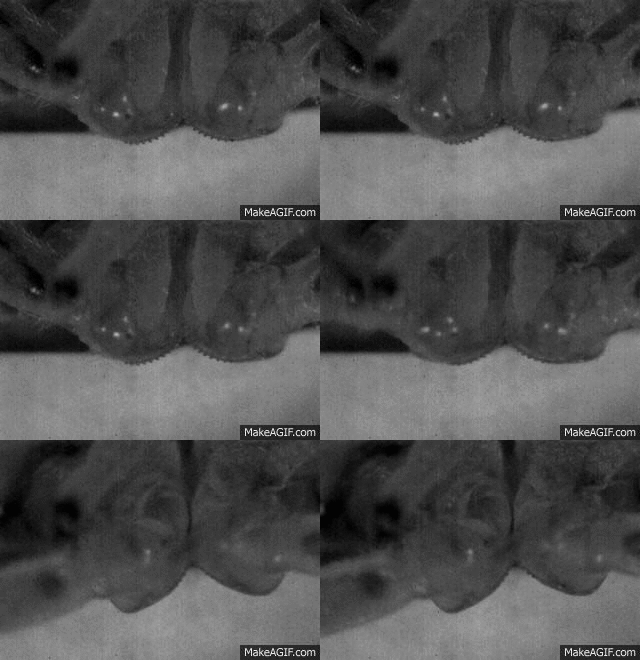
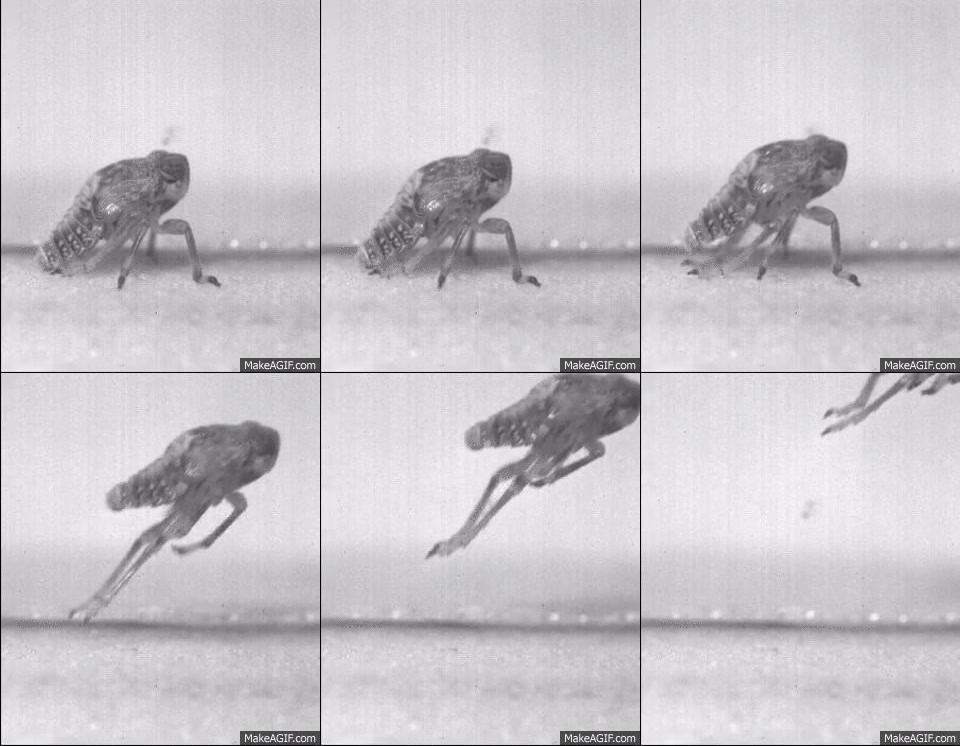
Synchronizing the jumping legs, these gears coordinate the action of simultaneous movement in both legs (first image below, hosted by makeagif.com). The design is essential for this little creature so its jump is synchronized. Moving at high rates of speed through the air, the insect would spiral out of control without this arrangement (second image below from makeagif.com).


Best Explanation 

As you study these beautiful images, reconsider what the host of that documentary expressed. Now tell me, what's your gut reaction, do these gears look designed or do the demonstrate mindless origins? I'm not asking what you think, but rather your first reaction? If you are like most, you have to agree, they appear designed.

A method that many use to answer historical science questions is to observe the present to understand the past events. While not every historical event may be deduced this way, many concepts can be elucidated. Every new design from our experience has been agent designed. I can' think of an exception. So why wouldn't we expect agent causation in the design in nature? Isn't the most reasonable explanation for the design in nature a mind?

It seems that biology has an habit of surprising us, why? We are stunned with the design we find in nature. Many times technology and biology overlap in design. We infer design in technology, is it not logical to infer design in biology as well? The design in nature seems to jive well well with our presuppositions of design, not chance and random like process. Intuitively we can detect design.
In addition, designs in nature seem to be optimally designed for the function intended. In fact, the designs are so good that we, in our quest for technology, copy biological designs in a field of study called biomimicry. We look in awe at biological artifacts and let them inspire us for tools we make. Technology, while amazing, is clumsily and klutzy in comparison to biology. Brilliant minds spend hours, days and years on designs that are far inferior to what we find in nature.

Elegance At Its Best

Again, let me ask you, from your intuition and from experience, can't you infer design? Your gut reaction is awe at the beauty of the gear design, you don't automatically infer randomness in mechanical like structures like this, do you? The only source of new design, from our experience, is intelligence. In fact, we can even learn from optimal designs in nature, including this gear. We are able to copy these structures, even though they are more elegant than our own mindful designs. From our intelligently designed technology, we come short. Biology has very advanced designs, while it seems illogical to infer origins from mindless process, it's not only natural but also logical to infer design on biological structures - even this gear.


(1) Burrows and Sutton. "Interacting Gears Synchronize Propulsive Leg Movements in a Jumping Insect" http://www.sciencemag.org

Tuesday, July 8, 2014

Mr. Kingfisher

Problem: Train needs to travel at 200 mph with very little noise-pollution.
Solution: The Shinkansen Bullet Train and a bird-watching engineer.

Excessive noise is generated when trains zip too fast, exiting tunnels. Thus a sonic boom. As it moves through a tunnel, pressure builds up in waves which causes this boom as it emerges. A bird-watching Japanese engineer, on the train design team, put his bird watching skills to work. Capturing the design from the kingfisher's head and beak, he designed the nose of the train.

Kingfishers dart into the water searching for fish - absent a splash and scarcely a ripple. Propelling through a low drag medium to an high drag medium causes shock. Circumventing this issue is accomplished by the exquisitely design of the beak. Now you see the solution for the train with a similar issue - low drag in the tunnel, high drag as it emerged. The wedge design of the kingfisher's beak was the needed key.

But get this, sound was not the only thing that was reduced, but also a fifteen percent less energy usage and an increase in travel speed by ten percent (1)!


(1) http://www.asknature.org/product/6273d963ef015b98f641fc2b67992a5e

Image source: Flicker Karen Roe


Tuesday, June 17, 2014

That thing that smells

A humans Nose (2)
OK, you know that thing that at times looks ugly, sticking out from your face? Yes, that thing that is messy when you have a little cold and has those few annoying hairs that stick out? Good, we are talking about the same thing here, just to be sure.

So let's ponder here, how many different smells do you think one's nose can discriminate? What would be your guess? Maybe three hundred, maybe a thousand? 

Try something over one trillion (1)! Yes, that is this number here: 1,000,000,000,000 or 1012. Again, that is one trillion different smells! Can't comprehend the large number, don't worry, you are not alone, most politicians can't either.

So, here's the moment of truth, the core question...how does this type of technology randomly evolve through natural processes? Design is apparent, it is self evident.


(1) Humans Can Discriminate More than 1 Trillion Olfactory Stimuli. http://www.sciencemag.org/content/343/6177/1370
(2) Image source: Wikipedia

Friday, February 28, 2014

Double Function: DNA Code and Duons

Cells are the "building block of life", they form organisms. Inside, DNA resides, storing the instructions that tell how to build proteins. Protein are made up of something called called amino acids. The instructions in the DNA are called genes. However, the DNA has other functions as well, it regulates some of the cell's activities.

DNA code seems to have multiple layers of information, from molecular tags. Much of the information outside of the DNA is called the epigenome.

While genes and epigenomes are interesting, there is evidence that DNA itself, the four letters that make up the DNA (A, T, C, and G), contain at least two layers of information. One that directs the sequence of the amino acids to make protein. The other helps regulate where types of molecular machines can copy the code to make RNA, an intermediate between DNA and protein. This is a regulatory function. These instructions are found many places on the DNA code. However, some of it is found coded right with the genes, in the same sequences that code for protein!

The sequence of the DNA is "nonrandom". This means that these genes are highly specified. They need to be, they are carrying at least two layers of information on some genes. The writers of the below study state the following: "The information architecture of the received genetic code is optimized for superimposition of additional information." This causes a simultaneous encoding of amino acids and regulatory information within exons, the parts of the gene that code for protein.

We only see information come from a mind. In this case, we have two layers of information, in the same "text". Think of reading a book. Now what if you turned the book and read it in another direction, ore even backwards. While doing this, the author has written more information that is with in the same text that you were just reading. You have a very compact book with couple layers of information. Just one layer of information points to a creator. However, given that we find at least two layers of information makes it even more stunning. Two layers makes it even more stunning and exponentially points to a mindful origin.


Stergachis, A. B. et al. 2013. Exonic Transcription Factor Binding Directs Codon Choice and Affects Protein Evolution. Science. 342 (6164): 1367-1372.

Sunday, February 23, 2014

Geckos and Robots


Gecko; Source (1)
Geckos are truly awesome creatures. One intriguing attribute is that they can walk on walls and ceilings. There is a secret however to this ability. Researchers have been trying to elucidate this secret for some time, and have come up with technology to mimic geckos toes. This includes glue, tape and a rubberized material used to make a gecko robot.

The secret of this mind boggling ability is biologically multilevel. Geckos feet and legs are lined with lamellae (image B), these are small ridges that form flaps. On each of these there are hairs called setae (image C & D). These little hairs divide into microscopic hairs called spatula (image E). These spatula attach to its climbing surfaces by weak chemical bond called Van der Waals forces. However, the spatula only stick in one direction. Detachment is easy, but the design is complex, they have rotational ankles so they can "stick" and then rotate to "un-stick".

Gecko's feet; source (3)
Researchers visioned a robot with the same wall climbing abilities. To mimic this sticking action, they designed a rubber-like material that has micro hairs on the surface. This adhesive does not just have hairs, but also the same lamellae design mimicked from the gecko. Lastly they attached this material to their robot called "Stickybot" (2)

What I find just a little curious is the quantity of research time (probably years), the amount of money needed, the vast knowledge base and many minds to make this thing work. The technology, chemical design and engineering also should not be forgotten. However, this Stickybot is still not as finely designed as our little lizard friend. Silly how a mindless process can do more amazing things they our brightest minds. Don't forget we copied this "mindless" design. I wonder....


(1)Gecko image 1: http://en.wikipedia.org/wiki/File:Gold_Dust_Day_Gecko.jpg
(2) More about the Stickybot: http://news.stanford.edu/news/2010/august/gecko-082410.html
(3) Gecko image 2: http://www.pnas.org/content/102/2/385/F1.large.jpg

Saturday, February 22, 2014

Things I Have Learned From Dr. Steven Meyer

Throughout the years I have listened and have learned from Dr. Steven Meyer. I agree with most concepts he presents, but do take exception to others. However, this post is not about this arguments, rather his methods and tactics in presenting and talking to those who oppose his views. I am impressed by how he handles himself in conflicting situations. Because of this, I have tired to isolate attributes that I can learn from.

There are three main categories: his personal attributes, his conflict handling persona, and how he argues his case.

Personal Character

He comes across as intellectual but illustrative, making the complex simple. His dress and demeanor does not draw attention away from his arguments. I remember him and his arguments, not some sort of jazz, fancy or sloppy clothing. While intellectual, he is still modest and minimizes himself in debate. He ignores it when people don't call him "Doctor" or when others minimize his credentials.

Handling Conflict

When I see him in conflict, he handles himself well. I think part of this comes for confidence and knowledge of the subject material. However, he is open to critique and is fair minded. He admits mistakes and he is willing to learn from his antagonist. He critiques the arguments rather than his antagonist. Lastly, he is quick witted and he is open to dialog with anyone.

Arguing His Case

I like how he argues his case. He makes modest claims which have much evidence. He uses what I would call "minimalist argumentation method," he focuses on things that provide the best arguments and gives the greatest evidence supporting those arguments. In other words, he uses only few topics but gives powerful arguments for them. This gives him less "turf" to defend. This allows him to stay focused and reduce sidetracking. Other issues are often baited in front of him, he does not budge, he stays focused and argues for his modest claims.


Saturday, February 8, 2014

Post Reverberations From Ham vs. Nye

I once talked to one who had a graduate degree in geology. He told me that one can't be a scientist without believing in evolution. While I already posted some of my thoughts concerning Ham's and Nye's debate, I want to take up this specific issue. After listening to Nye and many others in the social media world, I have been hearing the above concept go something like this: "you can't be a good scientist unless you believe in molecules-to-man evolution." I have two concerns one is this assertion does not follow, second I think the debate topic about if creation is good science is wrongly put, it should have been, can materialistic molecules-to-man evolution be good science.

Why does this specific issue not make sense? Let's look at a real world example. One can cook well at the same time believing in flying cookie monsters, leprechauns and mermaids. However, one does not have to believe in those to also cook well. The same goes for science, there are grounding precepts that have built the science concept over the years. These are in place no matter what a scientist believes. These included, uniformity, logic, math, repetition, drawing the best conclusions, information and peer review just to name a few things. All scientists need to believe in are things like these to do good science.

However, because science and reason have foundations upon the Christianity, one has to wounder how the belief that "you can't believe in creation and be a scientist" even makes sense. In fact, the field of science is based off the Christian world view, things are knowable, repeatable, logical, uniformity and there are ethics (right and wrong) that guides us while living life (1). God is the grounding for science. Without God, the Christian God, science probably would never taken off as an enterprise. It only took off once in history that we know of, that was in Europe. The early European scholars and scientists thought they could know why things work because they had a belief that the Christian God was rational, dependable, the creator and was lawful (1).

Even Tertullian knew that since God is a rational God, we can understand things and reason. He says the following:

Reason, in fact, is a thing of God, inasmuch as there is nothing which God the Maker of all has not provided, disposed, ordained by reason - nothing which He has not willed should be handled and understood by reason (2). 

That is why I am concerned when Christians put an artificial wall between reason and faith. This "wall" is based upon the the atheist world view. It is so prevalent in Christendom because of post-modernity and also atheist assertions. In fact it does not make sense. It is not "reason vs faith" or "science vs God." These are complimentary with each other.

I feel that a better debate question that would have put us on the offensive instead on the definitive should have gone something like this: "can materialistic molecules-to-man evolution be considered science?"


(1) Stark, Rodney (2003) "For the Glory of God", Chapter 2. Princeton University Press. page 147.
(2) Tertullian, On Repentance Chapter 1

Wednesday, February 5, 2014

Ham vs. Nye

Overall, I think Ham had strong foundational points, especially philosophically. Nye seemed to be stronger on the natural sciences but weak philosophically with no grounding for his would view.

Ham talked about the fact that Nye, a materialist, has no grounding for things like reason, science and morality. If the universe, including ourselves, are just banging molecules that stick together at times, then why do we have laws like math or how can we all reason and have a fairly accurate way of understating each other? What about aesthetics? What about the laws of uniformity which science is built upon? Nye can't give good responses for these origins because first there is no grounding in his world view, second a materialistic world view tries to ignore non tangible things that “science” can't explain. In fact this concept is strange on its own because the concept of science is itself non-tangible.

On the other end, Ham could have built a stronger design argument. I saw a slide in passing that talk about it, but this topic needed more focus. Another powerfully area that I feel that he should have focused upon was the origin of information such as contained in DNA and RNA. It is not explained by materialists except via “just-so” stories. Lastly, he should have pounded away at the foundation of the materialistic view of first life. I have not been impressed with the different theories nor do they satisfy traditional scientific rigor.

Also, when asked if any piece of evidence could cause him to question his view, I think he missed a great opportunity to say what Paul said, in that if Christ did not die and was raised from the dead, his faith would be in vain (1 Corinthians 15:12-30). By saying this it would have given him more credibly. Second, it would have been a great opener for a quick discussion of the unsuccessful attack upon the Christian foundation since the time of Christ. He also could have given the evidence that we do have reliable evidence for Christ's death and resurrection from our four primary sources: the Gospels.

Concerning Nye's arguments I was impressed that he used observations of the natural world to draw his conclusions. While Ham did do some of this, (such as no new information needed for bacteria to digest citric acid, rather it is done by just a "flipped" switch on a gene in that species of bacteria) he did not seem to do as well as Nye.

While I had many concerns with Nye's views, one was that he took out of context a line from the constitution. The constitution says the following concerning congress: “To promote the Progress of Science and useful Arts, by securing for limited Times to Authors and Inventors the exclusive Right to their respective Writings and Discoveries.” However, on stage he made it sound as if the writers of the constitution were referring to educating our youth, not authors and inventors.

Second, for him to use the word “science” from this document is a misrepresentation of it without proper definition in that day and time. In the old 1828 Websters dictionary, published 41 years after the constitution basically defines science in the broad sense of knowledge (this book was based upon his earlier dictionary from 1806 “A Compendious Dictionary of the English Language”). This is in opposition to some contemporary definitions which only try to limit it to understanding the natural, material world through the lens of natural causes.

I feel that his view was weak when he argued that to be a good scientist and engineer one must have a foundation in materialistic understanding of “science.” This makes no sense, many if not most of the fields of science and math were started and continue to be propagated by thinking Christians and other religious people. Second, the university system was started in the middles ages with many Christians leading the way. Many of the these early Christian scholars had a great tolerance for diversity of thought and arguments from different points of view. Third, without the grounding of the Christian world view, there would not even be science, math,  reason, etc.

If you can remember only two things here, first Nye's case is foundationless because of his materialistic world view. Second his case is groundless because this world view does not make senses logically when one looks at the origin of life issue. Both issues demonstrate lack of grounding which makes his case illogical.


Sunday, January 19, 2014

Antibacterial, The Good, The Bad and The Ugly

While talking to an office manger of a company who purchased, among other things, hand soap, I stated that I had noticed that she bought antibacterial hand soap. From her perspective it seemed better, hey it is antibacterial, bacteria are bad so let's get soap that kills them. However, I can think of three good reasons NOT to use antibacterial products unless in high risk environments.

1) there is excess exposure to not needed potentially harmful chemicals
2) many of the “good bacteria” that help you and protect you from the “bad bacteria” are kill off by these products
3) these products promote antibiotic resistance in bacteria *

However, this subject brings up another issue. In one of my past biology classes, the professor tried to use antibiotic resistance to demonstrate that “molecules-to-man” evolution was correct. However, there were a number of things he left out. He “forgot” to tell us that microbes scientists have been studying within the last couple hundred years have not evolved into a new type of organism, in fact, they have not even crossed the species barrier to become a new type of bacteria. One type of bacteria, E. Coli, has had its genetic structure changed by natural and human cause in the lab. They have been growing in diverse situations in the labs for millions of generations. Amazingly, these bacteria are still E. Coli. They many have different functions, or less functions, but they still have the characteristics of E. Coli.

You see, antibiotic resistance does not demonstrate “molecules-to-man” evolution, but rather highly designed organisms that are able to protect its population. Within its microbial populations, these antibiotic resistant bacteria do not function optimally under normal situations, but in an antibacterial environments they function well and keep the species alive. So that is the reason you should not use these antibacterial products indiscriminately.


* Antibiotic Resistance is a condition when bacteria become resistant or immune to some chemical that is designed to kill them. In other words, you take penicillin, an antibiotic, and it kills the “bad” bacteria. However, if there are bacteria within that population that are not effected by the antibiotic, then those bacteria will grow uncontrolled. Soon, if all the non-resistant bacteria are killed off, only the resistant ones will be alive. Resistance to antibiotics are caused in one of three ways: 1) some germs already had the resistance, in most any population of bacteria there are a very few bacteria that are resistant already to certain antibiotics, this creates a 'safety net' so that the bacteria will continue to survive even through adverse conditions. However some are even resistant before a certain new antibiotic comes out! 2) Resistance can be transferred from one germ to others, this can be achieved multiple of ways. 3) Some microbes can become resistant to antibiotics through mutation. This is when a gene in an organism is changed from highly organized to one that is degraded. This makes it act different, like it does not have a port that would uptake the antibiotic.

Tuesday, December 17, 2013

Santa Claus Christianity

"The most wonderful time of the year" projects many kid's imaginations into the realm of fantasy with Santa and the elves. Unfortunately, many Christian adults also have the same view of the Bible, it is fantasy. Now they would never say that, but their "reasoning" affirms this view. 

Some of my past students believe the Biblical creation account. However, in the same breath they say that the Bible and science are at odds. Not only that, but science has all the facts that point to naturalist mechanism for the origin of life. But...since they are Christian, they are going believe the Bible. 

In other words, Science has the facts (truth), the Bible is not factual (not true), but they are going to believe the Bible. In other words the Bible does not paint a picture of how the world really works, it is a fable, not reality, but they are still going to believe. 

This is not noble, rather it is unwise!

This type of thinking produces a baseless faith that leads to superstition. It is like a child believing in Santa Claus, there is no such thing, it is just in one's imagination. 

The Bible presents no such faith. The Scriptures show reality. It shows humans for what they really are. 

The middle-age philosophers were mainly Christian, which birthed science. Christianity helped birth the university system. This is not chance, Biblical understanding gave many the desire to learn more about how the world works. It is the Biblical concept of uniformity, God is the same yesterday, today and forever, that catalyzed the framework to believe that we could learn more. As Christians we know that everything has been designed at one point, which means there is purpose in structure, this drives new knowledge. 

In fact reason, logic, thought, information, math and morality, to name a few items, only make total sense when viewed through the lens of the Scripture. No, this is not a fable, we have the goods. Stand strong, learn, and understand that truly "the fear of the Lord is the begin of knowledge."

Friday, December 13, 2013

Elegant Design In A Cell

In freshman year biology, students learn the amazing complexities of the cell. For example, we have been told for years of the cells amazing four letter alphabet or the genome. Of course we know that information always comes from a mind, at least that is our everyday experience (books we read, conversations we have). Just this level of biologically understanding should point one to a creator. However, this is truly just the tip of the iceberg.

Other Information

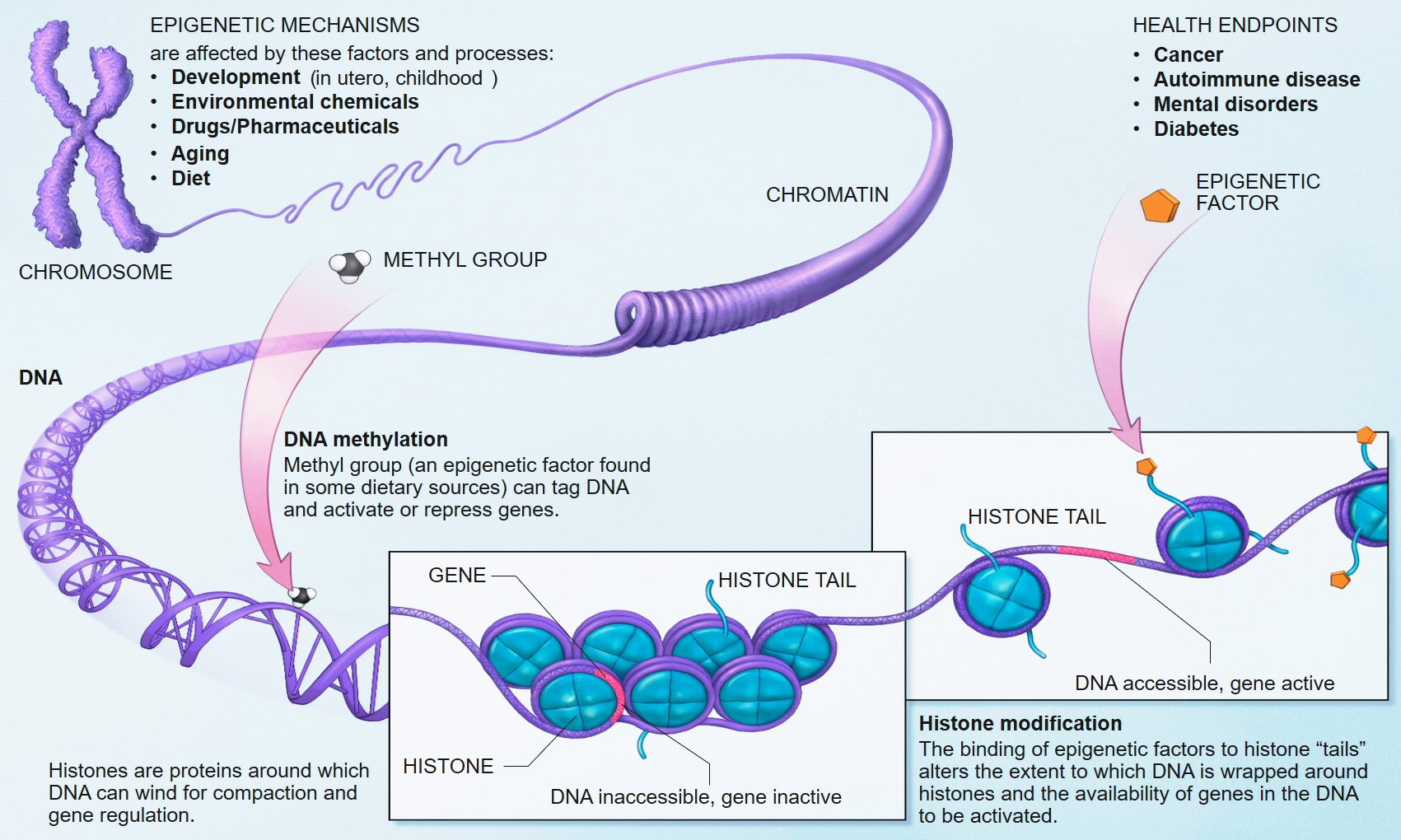
Epigenetic mechanisms: Click image for full illustration.
What most don't realize is that the DNA is not the only information carrier in the cell. RNA, a close cousin of DNA and copied from DNA, also caries information. But wait, that is not all, there are little, and not so little, tags on the genes that tell the cell to do certain things. These tags included methyl and acetyl groups among other tags.

Epigenetics

In fact, these tags are just the small part of a
n emerging field called epigenetics, layers of information above the DNA. Even the cell structure is now being recognized to hold information. Part of the internal cell scaffolding is now thought to contain parts of this information. More we learn about this information, the more complex just one cell gets. Material does not create information randomly or systematically. Information needs a mind for causation. This translates into what many of us knew already, designs like this need a designer.


Image source: "Epigenetic mechanisms" by National Institutes of Health

Saturday, September 15, 2012

Ancient Paint Workshop Challenges Human Evolutionary Story


In 2008, excavations in a South African cave uncovered two red-stained abalone shell bowls along with various tools in what was evidently a workshop where ochre and other ingredients were mixed, most likely for use as paint. Researchers examined the artifacts and have published a study in which they say the artifacts are 100,000 years old. Could they really be that ancient?

Read the rest of the article at : Ancient Paint Workshop Challenges Human Evolutionary Story

Join others & receive
my free blog posts &
resources. Get it now.