Showing posts with label intelligent design. Show all posts

Saturday, May 7, 2016

5 Amazing "Alien Technologies" in Life That Strike Down Darwinistic Evolution

Terrestrial Alien technology

Digging in the deep jungle tangle, you are in search for lost ancient civilizations. Finding primitive technology is your expected end because of the surrounding primitive cultures.

Your slow sleepy digging suddenly is awakened by the earth's yawning mouth, you are plunged down into the bowels of the earth. A hidden cavern awaits your arrival. Heart pounding, you crawl over the mess, and then you stumble into a maze of artifacts.

Sunday, April 10, 2016

One Life Mystery That Is Destroying Darwinism But Points To The Creator

Exponential Life - Epigenetics Deepens the Mystery of Design

I was blown away when the scientist said it; my mind yelled, "What? That's crazy!" His topic was the famous, or maybe infamous, tiny friend living down in our lower digestive tract, Escherichia coli (E. coli) bacteria. He said that, on average, any given strain of E. coli shares about twenty percent of its core genes with any other E. coli -bacterial strain. In other words, about twenty percent of the E. coli genes are shared by all strains, but around eighty percent can very throughout the species!*

One possible explanation for this phenomenon is that other information-carrying structures besides deoxyribonucleic acid (DNA) may partly define the E. coli's final shape. This was startling news to me, for throughout my early biology education, I had understood DNA to be something like destiny.*

Thursday, March 31, 2016

Has Science Killed God? Four Reasons Why That Idea Does Not Make Sense.

Some atheists say things like "science has fired God" or "science killed God." What about some who say "science is making belief in God obsolete and incoherent"? Or what about this, "we are getting smarter and we can now explain things without invoking God."

Just like a previous post, "Reason vs. Faith", where I argue that reason and faith are compatible, I want to make a similar claim here, science and God are compatible. There is no conundrum.

Most damaging to the "science makes God obsolete" idea, is science is dependent upon Christian ideology, like a child to her mother. Like the rest of life, such as beliefs and cultures, how we interpret the world is based upon the presuppositions that form our worldview. Science is no different. Modern science arose only once in history and in one place, Christian Europe. The culture was saturated with the Christian faith and philosophy.

Thursday, July 9, 2015

A Very Obvious Reason Biology Points To God! (Which You May Not Have Thought About)

Once I met a German engineer working to reinvent the vacuum cleaner. When I say reinvent, I mean that! A totally different design. If he and his team were successful, they would do well. If not, he would be knocking on doors for a new job.


Hard, Hard Work!

Engineers, designers and artists understand how hard it is to design. It is time intensive and there is great need for attention for highly specified patterns. Perfection is the goal, mistake free. As an artist draws the human face and or body, with realism, its a hard strenuous process. Those that do it well have spent years practicing. In fact, very few artists can draw a human well. There are patterns to be memorized, specifications to be accounted for and proper proportions are a must. Then there is perspective and foreshortening. This is just the copy of the human design, and it's hard, it's not the original creative design! Humanoid robots have another level of design, the amount of work is immense!

Designing is an emotional process, whether success or failure, praise or criticism. When one criticizes a design or if it fails, it is depressing. When successful, creativity is rewording and exhilarating. Designers and engineers are very sensitive to their creativity and hard work. The process of designing can be enjoyable as well.

Tuesday, May 26, 2015

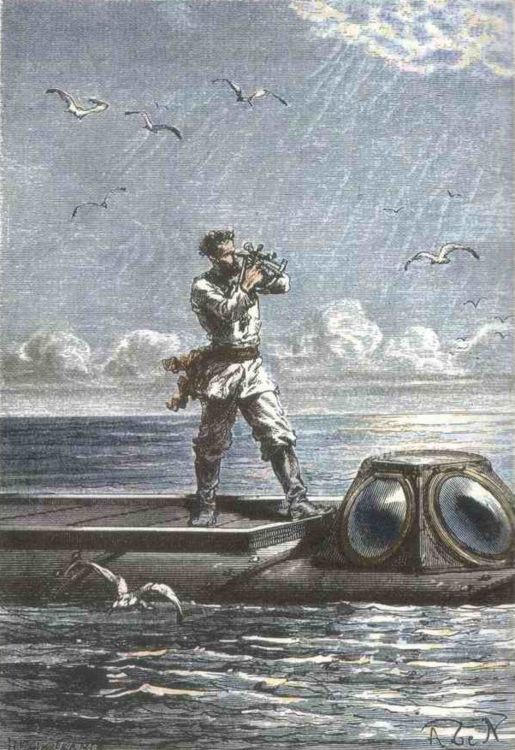
Captain Nemo And His Sub Expose This One Silly Belief.


Twenty Thousand Leagues Under The Sea

Verne's fictitious whaler characters chased Captain Nemo's stupendous submarine all over the ocean. Wild imaginations of a gigantic whale haunted them. You see, captain Nemo's design for his vessel, Nautilus, was somewhat based upon marine creature's hydrodynamic shapes.

Ideological Framework

The single most pervading intellectual ideology of our time (and maybe ever) is the materialistic, neo-Darwinian framework. Many feel that "nature designs" new biological structures. Functional? Complex? Specific? Meaningful?

What? a mindless process designing?

Minds vs. Material

Interestingly, from our experience, we never see natural process pregnant with engineering abilities. We never have. If this concept weren't couched in such technological language, plus holding such high esteem within academia, it would sound foolish.

In fact, the only design originator from our experience is a mind. Why would we ascribe the mindful enterprise to inanimate objects? Do non-animate objects have the capabilities of designing, imagining or communicating?

The same definition of nothing is the same as what rocks think about. Other inanimate objects think about the same thing.

Fall On Your Face And Worship That Stone!

When we look back at ancient cultures and the "uncivilized," we are humored by idol worship, how silly of those people to think wood and stove carvings are life's creators. Modernity strangely struggles with a similar scenario, with the more technical phrase “nature designs.”

https://feedburner.google.com/fb/a/mailverify?uri=IbiteThis strikes me as facetious. 

It takes multitudes of highly trained, intelligent minds to design a machine functioning like the fictional Nautilus. Hours of mindful fabrication and manufacturing are poured into the creation of submarines. Some are breath-taken, thinking that they're learning from nature's exquisite self-design, when in reality they're looking at seemly endless designs created by the Ultimate Mind.

If you enjoyed this topic and others like it, you can get the latest posts sent straight to your in-box! Please click here to be one of the first to receive the latest articles. You don't want to miss out! (Click here.) 


What biological designs interest you? Bioinspiration is a term to describe when we use these biological designs for new technology. How could you put them to work for yourself? Do you think that natural process have the ability to create complex, meaningful design? Why and how?


Image source: Wikipedia

Saturday, May 16, 2015

Neil deGrasse Tyson and Before the Universe

Near the end of his article (here), Neil deGrasse Tyson, an astrophysicist who stared in the series "Cosmos: A Spacetime Odyssey", talks about what was prior to the universe's existences.

After making some slightly disparaging remarks toward the theists view, he postulates a couple other "where the universe came from" ideas. The multiverse and it "just popped into existences from nothing". It seems that for himself, he holds to the safe and seemly intellectually superior skeptics view of "I don't know". Then he rises the good o'l question of if God did it, who made God?

The Two Main Competitors Problems

However, I'm blown away with the lack of cogency of the only two real competitors to an intelligent being: the infamous multiverse and the "popped into existences from nothing" views. I'm not trying to sound saucy here, but really, are those the best hypothesis out there?

The multiverse hypothesis has big problems, namely its conjecture in some minds and it's not really possible to demonstrate even if true. It seems to me that if multiverse true, you would still need something to bring them all into existence, who is that prime mover? Plus the complexity of making all those universes rises to infinity.

POOF, Like Magic!

So the naturalists view is still left with the universe(s) going "POOF"... into existence, for no reason? Nothing makes everything? Magic without a magician? I'm scratching my head.

Tyson concedes these views usually don't satisfy people, as you can see why. However, it seems to me he takes them more serious than the possibility of a "prime-mover."

So, Who Made God?

Seemingly, in an attempt to discredit a deity, one of his last questions (more or less rhetorical), asks the infamous question of "what was around before God?" or otherwise cashed out as "who made God?" This question has been answered by the fields of theology, history and philosophy.

The "who made God" question has this problem, who would have made the creator who made the creator? You see, it becomes an infinite regress of creator creating creators - forever. Silly, I know.

A preacher once preached that the Earth sits upon nothing (without getting technical about gravity). An old lady came up afterwords and said "I don't agree with you, the Earth rests on turtles." So the preacher asked "What's under those turtles?" She responded "more turtles." To which he replied, and under those?" Out of finality, she said, "turtles all the way down!"

So What About That God Question?

However, there is an answer to this question. A good one, quite simple and elementary. With just a little knowledge of theology, history and philosophy, Tyson should have known better (except for the fact that he seems to degrade the field of philosophy, while philosophizing). In philosophy this "prime-mover" is also called the "uncaused-first-cause". In other words, this "prime mover" has always been in existence, thus uncaused. He is not dependent upon the space time continuum. In fact, we read in history and theology (ie. the Bible), this exact thing - one who isn't dependent on time and who is eternal.

Even as a scientists he should have known better. We know from experience things that began to exist must have a cause. We know the universe had a beginning, came into existence. We also know that the causes must be outside of the thing that comes into existence. Outside the Universe there's no space, time or matter. To cause a universe and life, this cause must must be super powerful, smart and be able to make choices as well! Plus only minds cause the creation of large amounts of meaningful information, DNA anyone? This uncaused-first-cause must be spaceless, timeless, immaterial, eternal, smart, powerful, has a mind and personal. Ah, that sounds familiar....

What If We Did Not Know Who Made It All?

Even if there was no answer to this question, a being who created everything still seems to be a perfectly good argument. Just because we would not know who the "prime-mover" was, does not seem to effect the idea that there was an original "prime-mover." Does one have to know who painted a picture, carved a horse or even committed an homicide to recognize agent of causation?

Great Rhetorical Value?

But the question, "who created God", seems to be misleading. This rhetorical questions seems to be meant to raise questions in the uninformed mind. Seemly it is an attempt to discredit those who hold to this view. Even though he may view his ignorance as more intellectual, it seems that he created a straw-man for the theists, rhetorically dismissing it while trying to make it look unreasonable.

However, in reality, the most logically satisfying view is the one he seems to dismiss. It is the most logical and coherent. We have a robust worldview with amazing explanatory power. The naturalistic worldview is broken, having very limited explanatory power, a degraded view that has lame and tenuous answers - a view that does not match reality.

You will not want to miss the next posts. If you found this one helpful, you will want to keep an eye open for others. The best way is to click here, because you can get them straight to your inbox so you don’t miss out! (Click here.)

So, what's your view? Do you agree with Tyson? Or does a Creator seem to be the best explanation? Why?


Image source: "Tyson - Apollo 40th anniversary 2009" by NASA/Bill Ingalls. Licensed under Public domain via Wikimedia Commons

Friday, April 10, 2015

Biomimicry's Amazing Potential For New Designs in Technology

It was 1948, George was out walking his dog through the Swiss Alpines, when he was attacked by nature's nemeses, the cocklebur. As he plucked these annoying structures off his clothes, inspiration flashed across his mind, inspiration from the common, annoying bur.

Along with his friend, he created what he called “locking tape”, but that name never stuck. We known it as … Velcro.

https://feedburner.google.com/fb/a/mailverify?uri=Ibite Biomaterials

You see, biology hides amazing structures, materials and chemicals. They are energy efficient designs, biodegradable materials and chemicals that heal and protect. In addition, biomaterials are manufactured at body temperature! Compare that to our manufacturing practices - high temperature.

Biomimicry

These master designed biomaterials are stupendous. We, as intellectual humans, have spent millennia engineering. We have been perfecting the manufacturing art and amassing our knowledge of technology and materials. However, nature's structures and systems are superior to ours. There abides brilliant designs, fine tuned “technology”, systems that outperform ours. In the quest to solve real world problems, organisms harbor superior information infused systems. In fact, some engineers make it their business to mimic these super designs. We call this biomimicry.

Termites and Temperature control

Consider, if you would, our temperature controlled buildings. Our houses, office spaces and industrial complexes use lots of energy. Is there a design in nature that is somewhat more efficient than ours?

Travel with me to south Africa, and check out the termite mounds that stud the region. Some of these reach the height of 10 feet. These structures are impressive, they have intrinsic temperature controlled systems. These termites “farm” a fungus for food which grow best at exactly 87 degrees Fahrenheit. But listen to this, the ambient temperature ranges from 35 to 104 degrees Fahrenheit! A circulatory system of cooling vents are opened and closed for temperature control. Plus these networks keep the mounds at perfect moisture and oxygen levels.

Can we learn something from these? Designers, using the principles of termite mound ventilation, designed an 18-story shopping complex. Mechanical air conditioning and heating are absent, yet this building remains comfortable. Using its ventilation network, breezes pull fresh air through the building. This building is uses just 10 percent of a traditional building's energy usage.

Conclusion

So can we solve some of our energy, design and pollution problems using biological solutions? Yes. Some of these structures are stronger and lighter than ours. All are biodegradable. All manufactured at mild temperatures. All are environmental friendly. This is an exciting time to be in science and technology!

One can see the mind behind these structures. The designs are beautiful. The uses are abundant. The applications are exciting. The keener we are to these master designs, the better a steward we will be with the gift of nature. The more we talk, think and use biomimicry, the more aware we can be to apply them to novel areas.

If you enjoyed this topic and others like it, you can get the latest posts sent straight to your in-box! Please click here to be one of the first to receive the latest articles. You don't want to miss out! (Click here.)


What other uses of biology can you think of that has helped technology? Do think these structures help point to a designer? 


Image source: Filcker/Joe Ross

Saturday, January 31, 2015

New Research Says Life Started Hot, But Here's What They Won't Tell You.

Up From a Hot Micropore We Arose – Did Life Start Hot?

In a recent Nature Chemistry article, we are informed that some scientists feel they may have found a mechanism for the formation of life’s precursors, DNA replication in hot rock micropores [1]. An experiment was set up to mimic hot rock’s micropores in the supposed early earth environment. However, this experiment unintentionally demonstrated that naturalistic process could not have started first life, rather a mind is needed.

Monday, January 5, 2015

The Gaps that Naturalism Fails To Answer (And What It Means For You)

Interesting conversation

Recently, I had the opportunity to communicate with some people about origins. I pointed out that naturalism, as a world view, has many problems. Problems such as the lack of explanation for the formation of the laws of physics, the reason that there is something rather than nothing, the origin of life's building blocks, the information source within the cell and the origin of life. One must say that these are big issues. Real BIG! I was perplexed when one responded with something to the effect of “these are just small gaps that we have not yet explained, you are just pushing your God into the gap.”

My response was simple - these are not small gaps, they are LARGE gaps, so large that they are the foundation of existence!

Another thing befuddles me, many Christians swallow the naturalistic world view “hook, line and sinker.” Many feel that naturalism can explain the origin of life and information. It can't intrinsically. They exchange a robust world view with amazing explanatory power for a degraded view that has lame and tenuous answers - a view that does not match reality!

IBITE Science Facebook page!

Switching gears to a new topic, I want to note that we have a new Facebook page for those of us who like science, but are disillusioned by the closed minded and naturalistic mindset that dominates many popular sites. Here's the Facebook description:

IBITE Science is a network of scientists and people who like science.

Natural science is the search for causes and truth in the universe. It is the intellectual and practical activity of studying structure and behavior while accumulating knowledge through the scientific method. Sometimes the evidence points to natural phenomenon, and other times to intelligent causes. We are open-minded. In other words we try to "follow the evidence where it leads."

In addition, we want to be both edgy and just have fun a times.

There you go, feel free to like the page and the posts! Even if science is not your field, interesting memes and articles are linked there. Please feel free to interact on the page as well! https://www.facebook.com/ibitescience

Wednesday, December 17, 2014

On Discrimination and Noah's Ark

During the last few years, Ken Ham’s organization, AIG, has been spearing heading a project to build a full size replica of “Noah’s Ark.” One may not be interested in this project, agree with it, or even go to see it, but, it would seem to me, most would be like “great, if it brings money into the state, more power to them.” Interestingly it is not this way. They have been denied tax incentives because of two reasons:

1. The park owners want to have the right to hire per religious preference.
2. Have the ability to tell others of their religious views.

Practice What You Preach

However, it seems to me, the state is doing exactly what they are accusing this organization of doing: discriminating against those of a different view. Some parks are just for fun, others have more educational aspects such as history, religious education or science. Shouldn't they all have equal access to tax rebates? In fact, this park tries to combine all of these types of parks (even if one disagrees with their conclusions). Is “discriminating” now correct when another “discriminates?” This seems to be a self-defeating position.

Is It That Bad?

In addition, "discrimination" is made out to be a “bad” thing in this case – but why this type of situation? Governments and business do it all the time. In fact you do it too! Why else do businesses drug test people? Why don’t they hire engineers who have not gone to school? Why don’t hospitals hire a welder for a physician position? Why don’t you let anyone move into your house? Why don’t you allow robbers to enter – why do you lock your doors? Why did you marry the one who showers once a day instead of one who showers once a year? These practices are all discriminatory – but is this case different? I think they have the right to decide who they want to hire. If the state wants to discriminate, then they need to call it for it really is – they are “discriminating against non-materialistic worldviews". They don't discriminate against those who hold to a materialistic worldview.

Discrimination At Institutions and Governments

Look at government run institutions that only hire those of the same view point. Think about the educational system, I have personally meet and talked to teachers and scientists who have been demoted, denied a job, fired or had there articles denied in magazines and journals - because of their worldview. Why? Simply because they held to the view that the universe, to some level, had been designed by an intelligent agent. Talk about tolerance, diversity and being non-discriminatory!

Worldview Issue

You see, the foundational issue here is not Ham's boat or even one's science job, but rather worldviews. Nor is the pivot of this issue over religious views. It's the question of whether or not the universe was designed! That is foundational! The line of demarcation is design or no design. The fulcrum is materialism or theism. Both are worldviews, both try to explain our human experience.

However, it seems that preferential treatment goes to one worldview in our cultural – the one that feels that nature is all that exists. Even though this view is weaker in its explanatory power, it is more attractive because of its false sense of immunity to ultimate authority.

This skewed sense of morality leads to strange positions such as "discrimination is good dished out to those who hold to a view of a designer". It seems like it is a one way street by our culture's standards - it's good and upright one way, but the other....immoral and intolerant!

You will not want to miss the next posts. If you found this one helpful, you will want to keep an eye open for others. The best way is to click here, because you can get them straight to your inbox so you don’t miss out! (Click here.)

What are your thoughts? Do you know of cases or have you ever been "discriminated" against because you have a theistic worldview?


Friday, November 14, 2014

What Is The Difference Between Shannon Information and Specified Complex Information? And why it's important.

Information is interesting, here I want to specifically discuss Shannon Information verses Specified Complex Information. I know, you may be saying "so what, it sounds boring to me." Maybe so, it may even zip over your head, in that case duck so it will hit the person behind you! While being of an esoteric philosophical nature, I think it's significant because of its implications.

The Difference Between Shannon Information and Specified Complex Information
The Difference Between Shannon Information and 
Specified Complex Information
There's a view that information in DNA and biological systems contain just Shannon Information - this is not true. Yes, biological systems do contains Shannon Information, but it is more specific than that - it contains Specified Complex Information. Let me first define the two and then tell you why biological systems have Specified Complex Information and why this discussion is so important.

Shannon Information verses Specified Complex Information

Shannon Information is only concerned with the improbability or complexity of character strings. In other words, it's just mere complexity or it has information-carrying capacity. Specified Complex Information on the other hand, is complex, but also has patterning significance. This is functional information that carries meaning. 

Let me put it this way, all Specified Complex Information is Shannon Information, but not all Shannon Information is Specified Complex Information (see bottom half of the meme). For example, Shannon Information just means that a string of characters are complex and improbable in their arrangement, but it does not define if this string carries significant meaning. Again, Specified Complex Information is specified and always carries meaning.

For example, this is Shannon Information:
“dfsad sdaf oije .zvsdlkfjas sdlfj” and also can be “Learning about information is fun!” 
However, Specified Complex Information always carries meaning: 
“Learning about information is fun!”
“dfsad sdaf oije .zvsdlkfjas sdlfj” is not specified functional information - at least as far as I know, it holds no meaning to an English speaker!

In case you did not get that, let me put it this way. Consider a key and lock. You can take a key blank and file down any pattern on the key blade - that is Shannon Information. However, if you want the key to fit the lock, you have to cut the key blade to specified sequences, shapes and depths for proper key-lock fit. Now that is Specified Complex Information.

Biological Systems and Text on the Page

Now both the text you are reading and DNA are improbable and complex. However, both carry meaning. The text you are reading is telling you something in English. DNA contains information that transcribes to RNA that gets translated to protein. In fact those sequences must be in a specific order else the organism will not produce the correct protein, a protein that does not function well or maybe none at all! The organism's enzymes must be able to transcribe it, if there is no correct sequence, there is no transcription.

Why Know the Difference?

Oh, by the way, just so you know why this distinction is so important, Specified Complex Information is only generated from a mind. In fact, that is the only source we know of that produces this type of information! Think of the text you are reading now, it has come from my mind. Thus this leads to the conclusion that life's specified informational core is grounded in intelligence - an intelligent mind!


Have you heard materialists say the "DNA is just Shannon Information" so it can arise by chance? What do you think, have you gained a new level of respect for "Information theory?"

Friday, November 7, 2014

FALSE: Adam Did Not have One Less Rib Than Eve

Introduction to Anatomy & Physiology, professor lecturing - I can still picture it even though it was back in the first year of the new millennium. “Men and women on average have 24 ribs” he said. And then he said: “no, men don’t have one less rib”, he want on “that was only Adam.”

First I was kind of surprised he would even bring up a biblical account, many have gotten in trouble talking about anything biblical in a science class, not counting more or less the part of the creation account. However, something else hit me, raising my hand I said “Maybe Adam did have a complete set of ribs, I understand that the rib is the only human bone that can regenerate sections after removal.” “No” he said, “bones don’t grow back, they can heal, but not grow back.”

As the years slid forward, that interaction never left me. A few years later I set out to track down the truth, was I correct? That’s when I ran across an article by Dr. Carl Wieland who told of a previous accident that caused the loss of some of his bone. To replace the missing bones, his surgeon used sections from his ribs - because they regenerate (1)!

As a born and raised thinker and researcher, I went deeper. After searching online, I came across and contacted a few surgeons around the world who seemed to have some knowledge in this area. Over and over I heard the same, yes they use bone from the rib and it regenerates back (2). Even recently researchers also confirmed this same action with rib cartilage (3).

You see, when a surgeon removes the a section of the rib bone they leave a surrounding tissue, called the periosteum, in place. Stem-cells are abundant in this tissue and they regenerate new rib bone.

So, did Adam have one less bone than Eve? Did God know what he was doing when he picked the bone he did to make Eve? Maybe the same God who made him really did know what he was doing, surprise, surprise!

What are your thoughts? Has an experience like this ever happened to you? Have you been told that men are less a rib compared to women? 


Sources:
(1) Wieland, Carl. "ADAM’S RIB: CREATION & THE HUMAN BODY." https://legacy-cdn-assets.answersingenesis.org/assets/pdf/radio/adamsrib.pdf

(2) Personal email correspondence with a number of surgeons, one was Dr. David Pennington whose name was mentioned in the article that I came across. Also, see this site: http://www.scoliosis.org/resources/medicalupdates/ribthoracoplasty.php

(3) Healing power of 'rib-tickling' found by researchers. http://www.sciencedaily.com/releases/2014/09/140913141423.htm?

Srour, M., Fogel, J., Yamaguchi, K., Montgomery, A., Izuhara, A., Misakian, A., Lam, S., Lakeland, D., Urata, M., Lee, J. and Mariani, F. (2014). Natural large-scale regeneration of rib cartilage in a mouse model. Journal of Bone and Mineral Research, p.n/a-n/a.

Wednesday, September 3, 2014

Gears

Covering the design company IDEO's product design process, the host of the documentary called “IDEO Deep Dive” said something to the effect of “everything besides nature was designed.”

The Gear

Consider the lowly gear – classically an iconic element to indicate human technological progress and design. We all have seen them - mundane right? Actually no. Gears aren't interesting because of their boring shape, but rather because of the design criteria needed for proper function. Nor are they arbitrary or haphazardly designed and fabricated. Teeth and gear spacing, proper alignment and material type, and optimal size and shape are all essential.

As ancient as almost any other human technology and as human of a design as they come, I think we would be stunned if nature contained a beautiful geared system. One is technology, the other is biology. Gears are very mechanical and systematic, seemingly very different than the organic nature of life.  I want to changeable this notion.

The Nymph

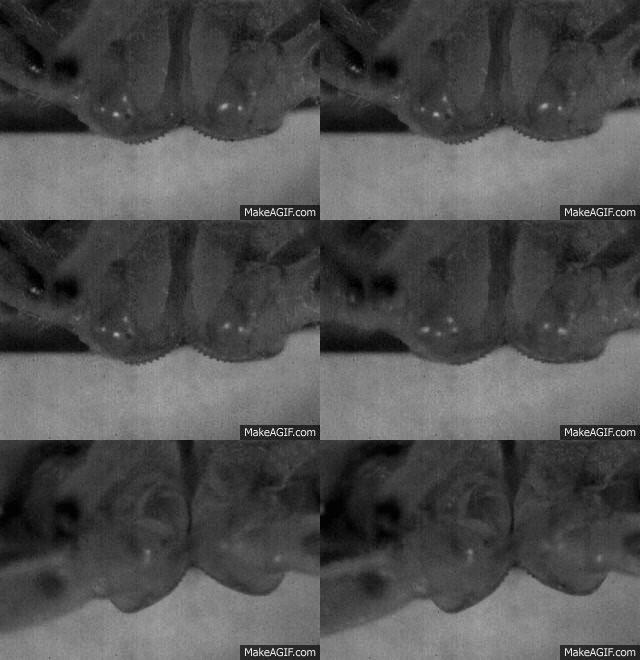
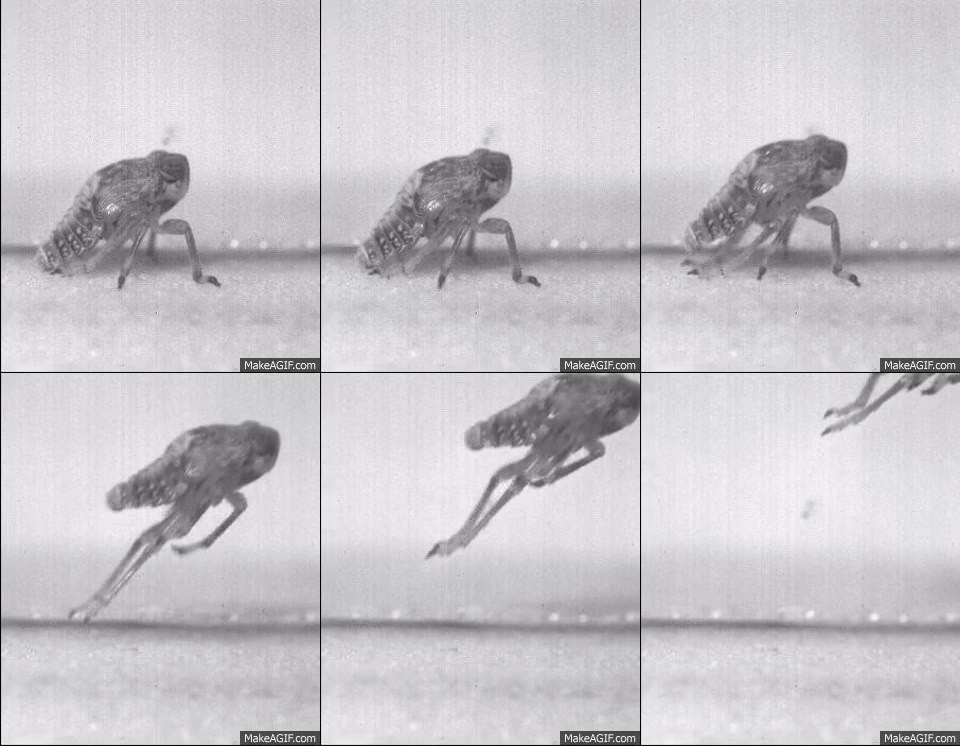
An unremarkable English insect took the biological world by surprise some time ago, the Issus nymph (1). Interlocking gears studs the trocantera this insects hind-legs (above image hosted by gizmag.com).

Synchronizing the jumping legs, these gears coordinate the action of simultaneous movement in both legs (first image below, hosted by makeagif.com). The design is essential for this little creature so its jump is synchronized. Moving at high rates of speed through the air, the insect would spiral out of control without this arrangement (second image below from makeagif.com).


Best Explanation 

As you study these beautiful images, reconsider what the host of that documentary expressed. Now tell me, what's your gut reaction, do these gears look designed or do the demonstrate mindless origins? I'm not asking what you think, but rather your first reaction? If you are like most, you have to agree, they appear designed.

A method that many use to answer historical science questions is to observe the present to understand the past events. While not every historical event may be deduced this way, many concepts can be elucidated. Every new design from our experience has been agent designed. I can' think of an exception. So why wouldn't we expect agent causation in the design in nature? Isn't the most reasonable explanation for the design in nature a mind?

It seems that biology has an habit of surprising us, why? We are stunned with the design we find in nature. Many times technology and biology overlap in design. We infer design in technology, is it not logical to infer design in biology as well? The design in nature seems to jive well well with our presuppositions of design, not chance and random like process. Intuitively we can detect design.
In addition, designs in nature seem to be optimally designed for the function intended. In fact, the designs are so good that we, in our quest for technology, copy biological designs in a field of study called biomimicry. We look in awe at biological artifacts and let them inspire us for tools we make. Technology, while amazing, is clumsily and klutzy in comparison to biology. Brilliant minds spend hours, days and years on designs that are far inferior to what we find in nature.

Elegance At Its Best

Again, let me ask you, from your intuition and from experience, can't you infer design? Your gut reaction is awe at the beauty of the gear design, you don't automatically infer randomness in mechanical like structures like this, do you? The only source of new design, from our experience, is intelligence. In fact, we can even learn from optimal designs in nature, including this gear. We are able to copy these structures, even though they are more elegant than our own mindful designs. From our intelligently designed technology, we come short. Biology has very advanced designs, while it seems illogical to infer origins from mindless process, it's not only natural but also logical to infer design on biological structures - even this gear.


(1) Burrows and Sutton. "Interacting Gears Synchronize Propulsive Leg Movements in a Jumping Insect" http://www.sciencemag.org

Tuesday, July 8, 2014

Mr. Kingfisher

Problem: Train needs to travel at 200 mph with very little noise-pollution.
Solution: The Shinkansen Bullet Train and a bird-watching engineer.

Excessive noise is generated when trains zip too fast, exiting tunnels. Thus a sonic boom. As it moves through a tunnel, pressure builds up in waves which causes this boom as it emerges. A bird-watching Japanese engineer, on the train design team, put his bird watching skills to work. Capturing the design from the kingfisher's head and beak, he designed the nose of the train.

Kingfishers dart into the water searching for fish - absent a splash and scarcely a ripple. Propelling through a low drag medium to an high drag medium causes shock. Circumventing this issue is accomplished by the exquisitely design of the beak. Now you see the solution for the train with a similar issue - low drag in the tunnel, high drag as it emerged. The wedge design of the kingfisher's beak was the needed key.

But get this, sound was not the only thing that was reduced, but also a fifteen percent less energy usage and an increase in travel speed by ten percent (1)!


(1) http://www.asknature.org/product/6273d963ef015b98f641fc2b67992a5e

Image source: Flicker Karen Roe


Tuesday, June 17, 2014

That thing that smells

A humans Nose (2)
OK, you know that thing that at times looks ugly, sticking out from your face? Yes, that thing that is messy when you have a little cold and has those few annoying hairs that stick out? Good, we are talking about the same thing here, just to be sure.

So let's ponder here, how many different smells do you think one's nose can discriminate? What would be your guess? Maybe three hundred, maybe a thousand? 

Try something over one trillion (1)! Yes, that is this number here: 1,000,000,000,000 or 1012. Again, that is one trillion different smells! Can't comprehend the large number, don't worry, you are not alone, most politicians can't either.

So, here's the moment of truth, the core question...how does this type of technology randomly evolve through natural processes? Design is apparent, it is self evident.


(1) Humans Can Discriminate More than 1 Trillion Olfactory Stimuli. http://www.sciencemag.org/content/343/6177/1370
(2) Image source: Wikipedia

Thursday, May 15, 2014

Life's New Language

Artistic DNA molecule. Flicker/Keith Ramsey
For one who follows the world of biological news, one but can't help but have seen the news flash of "alien DNA" being incorporated into bacteria. It seems that many are praising the scientists as if it were some great and humanitarian leap for our progeny. However, is the hype accurate?

Yes, it is quite interesting that a group of scientists, Floyd Romesberg and team from Scripps Research Institute, were able to manufacture chemicals that were quite different from DNA's four bases: adenine, thymine, cytosine and guanine (A, T, C and G respectively). To be frank it think the research is quite interesting. 
The bases engineered by Romesberg’s team are more alien, bearing little chemical resemblance to the four natural ones (1).
These new alien DNA bases, d5SICS and dNaM, were integrated into the microbes genome - this is the core of all the hubbub. Enzyme machines that help copy and translate the genetic code were able to interact with these novel bases.

Some are saying that we may be able to manufacture new drugs and unprecedented cures come from this research. In other words, with new letters one will be able to make new genetic words, which will expand the potential protein results.

My Perspective

However, I do have ten observations concerning this study, some on the skeptical side:
  1. Great, they accomplished adding new, man-made bases to a bacteria's DNA. But at this time the cell has no way of making more, if the microbe's human farmers discontinue supplying the cells with these bases, these bases will no longer be coded within the cell. Traditional bases will replace these artificial bases places.
  2. These bases are said to add information potential of the genome. This may be good, however, even with our computer systems, with only two "alphabets" (0 and 1), we are able to make images, videos, text, music, manufacture complex 3D objects and you name it. DNA already has twice as many "alphabets" as our technology, four bases (not counting the 64 codon combinations and used to put together 20 amino acids).
  3. OK, we have two new bases, so what about the RNA and all the protein complexes that help make protein? Yes, we can copy the text, but what about protein manufacturing? It is one think to copy text, but it is another to use text to build an aircraft. There is a whole level of magnitude above this accomplishment needed to even think about making protein.
  4. Proteins are made up of amino acids. The are attached to something called tRNA and are used to help build protein. So one is going to have to build "machines" help specify new amino acids to the correct new bases that make up the tRNA. Where will these machines come from? How will they be coded? What molecular machines will be automated to make them? There is a vicious loop going on here.
  5. To make protein, we need amino acids. Even if we get amino acids to "stick" to the novel tRNA and rRNA, we have to get the amino acids to form protein.
  6. We finely make a new protein. But form equals function. In other words, a protein needs to be folded just right for very specific jobs. Little machines, called chaperons, help fold proteins in the correct and usable shapes. Where are these new chaperons coming from for the new proteins with new types of amino acids? In other words, new code and new machines will have to be designed to fold the new proteins into correct orientations to even be potentially usable.
  7. They credit the origins of our current nucleotide bases to evolution through deep time. No intelligent source is invoked. However, it took a group of intellectual researchers over fifteen years to just get these microbes to uptake and replicate these artificial letters. This does not count the many other researchers, since the 1960's, who also have been attempting to work toward this goal. It took intelligence to get as far as they did, how could a blind, undirected process come up with four bases? It is even worse than that, think about it, as of now, the microbes can't even uses these bases for anything. They just sit there and get replicated. This hole system is irreducible complex, unless all the parts were in place in the first cells, the original bases would not have functioned.
  8. Along with this, we only know of information arising through intelligent minds. It is the inferences to the best explanation and the law of uniformity. Pure naturalism is not enough. As said on the point above, this study demonstrates this argument lucidly.
  9. Lead researcher Romesberg said the following within a piece in Nature: "If you read a book that was written with four letters, you’re not going to be able to tell many interesting stories" that is why these new bases are important, they will extend the informational content (1). Again, sounds good except for when one looks at even a simple cell, one is totally amazed by the stunning design and complexity. It makes our greatest accomplishments seem like foolish children's play. The biological story is one of the most interesting "stories" that can be told!
  10. Lastly, a quote from Romesberg states the following: "This shows that other solutions to storing information are possible and, of course, takes us closer to an expanded-DNA biology that will have many exciting applications—from new medicines to new kinds of nanotechnology" (2). Why does it seem as if all cutting edge (maybe on the offbeat side) "research" is argued  to help with health, medicine or improve technology? It seems to me that they trying to validate their research by saying "hey, this sounds a little silly, but it really does have importance." OK, maybe I am cynical, but that's what it sounds like!


(1) Callaway, Ewen. "First life with 'alien' DNA" http://www.nature.com/news/first-life-with-alien-dna-1.15179
(2) Scripps Research Institute Scientists Create First Living Organism that Transmits Added Letters in DNA 'Alphabet'. http://www.scripps.edu/news/press/2014/20140507romesberg.html

Wednesday, April 9, 2014

Genetically Modified Tomatoes

Are genetically modified (GM) foods bad for you? This is a controversial topic and at this time I am not going to talk about that question entirely. Nor am I here right now to discuss the ethics of manipulating genes. However, recently there was a study that pointed out that there were no large unintended genetic consequences in the GM tomato's which were designed to resist ripening.
When the scientists compared the biochemicals of the GM tomato and a wide assortment other non-GM tomatoes, including modern and heirloom varieties, they found no significant differences overall. Thus, although the GM tomato was distinct from its parent, its metabolic profile still fell within the "normal" range of biochemical diversity exhibited by the larger group of varieties. However, the biochemicals related to fruit ripening did show a significant difference -- no surprise because that was the intent of the genetic modification (1).
All in all, it seems that the scientists were able to edit the genome as they intended with no other large unintended genetic changes, which is good. But I do have two questions. First do these "extended ripening genes" have any adverse human consequences? Second, for this tomato it sounds like these ripening genes still fall within the normal tomato range of genes. But what is this "normal" range and what measurement did they use?

(1) Crop Science Society of America. "New approach to detecting changes in GM foods." ScienceDaily. ScienceDaily, 3 April 2014. <www.sciencedaily.com/releases/2014/04/140403131942.htm>.

Friday, March 21, 2014

"Superbugs" In Sewage

Image source: Iqbal Osman/Flickr.
"Superbugs" have been found breeding well in Chinese sewage plants.

Tests at two wastewater treatment plants in northern China revealed antibiotic-resistant bacteria were not only escaping purification but also breeding and spreading their dangerous cargo.
Joint research by scientists from Rice, Nankai and Tianjin universities found "superbugs" carrying New Delhi Metallo-beta-lactamase (NDM-1), a multidrug-resistant gene first identified in India in 2010, in wastewater disinfected by chlorination. They found significant levels of NDM-1 in the effluent released to the environment and even higher levels in dewatered sludge applied to soils (1).

How do they become resistant?

Antibiotic resistant bacteria become resistant when there's a mutation or they acquire an antibiotic resistant gene from another bacteria. Even though we think that this is bad, from the bacteria's perspective it gives them greater flexibility in different environments.

Does this prove evolution?

Some have advocated that superbugs are evidence for macro-evolution. However, this is not so. These resistant bacteria are still bacteria before and after they have the gene. They have never changed to a different type of creature. In fact, some bacteria have had the capability to be resistant to our antibacterials even before those antibacterials were marketed. These means that these capabilities were already built in to the bacterial population for greater survival potential.

(1) http://phys.org/news/2013-12-superbugs-sewage.html#jCp

Friday, March 7, 2014

Throw Your Genome Away!


In a recent article by Dr. Tomkins, he writes the following:
It was once believed that the regions in between the protein-coding genes of the genome were wastelands of alleged nonfunctional “junk DNA.” However, we now know that these previously misunderstood regions are teeming with functional activity—and a new study shows they are actually required for life (1).
The idea of junk DNA is another area where the evolutionary ideology has failed us. Only about 1-5% of the DNA codes for protein. The rest of the DNA was assumed by many to be leftovers from evolutionary ancestors.  Most who held to this view were biologists with evolutionary presuppositions. Directly steming from this assumption, much of the genome regions went unexplored for years.

Now we know different. In fact most of the DNA has been assigned roles, very important roles within the cell. Interestingly, many of those who held to the view of life originating from a deity, have for years theorized function to most of the "junk DNA". Truly, as the old saying states "ideas have consequences."

(1) Quoted text and image are from the following source: Jeffrey Tomkins, Ph.D., . N.p.. Web. 3 Mar 2014. <http://www.icr.org/article/7875/>.

Friday, February 28, 2014

Double Function: DNA Code and Duons

Cells are the "building block of life", they form organisms. Inside, DNA resides, storing the instructions that tell how to build proteins. Protein are made up of something called called amino acids. The instructions in the DNA are called genes. However, the DNA has other functions as well, it regulates some of the cell's activities.

DNA code seems to have multiple layers of information, from molecular tags. Much of the information outside of the DNA is called the epigenome.

While genes and epigenomes are interesting, there is evidence that DNA itself, the four letters that make up the DNA (A, T, C, and G), contain at least two layers of information. One that directs the sequence of the amino acids to make protein. The other helps regulate where types of molecular machines can copy the code to make RNA, an intermediate between DNA and protein. This is a regulatory function. These instructions are found many places on the DNA code. However, some of it is found coded right with the genes, in the same sequences that code for protein!

The sequence of the DNA is "nonrandom". This means that these genes are highly specified. They need to be, they are carrying at least two layers of information on some genes. The writers of the below study state the following: "The information architecture of the received genetic code is optimized for superimposition of additional information." This causes a simultaneous encoding of amino acids and regulatory information within exons, the parts of the gene that code for protein.

We only see information come from a mind. In this case, we have two layers of information, in the same "text". Think of reading a book. Now what if you turned the book and read it in another direction, ore even backwards. While doing this, the author has written more information that is with in the same text that you were just reading. You have a very compact book with couple layers of information. Just one layer of information points to a creator. However, given that we find at least two layers of information makes it even more stunning. Two layers makes it even more stunning and exponentially points to a mindful origin.


Stergachis, A. B. et al. 2013. Exonic Transcription Factor Binding Directs Codon Choice and Affects Protein Evolution. Science. 342 (6164): 1367-1372.

Join others & receive
my free blog posts &
resources. Get it now.